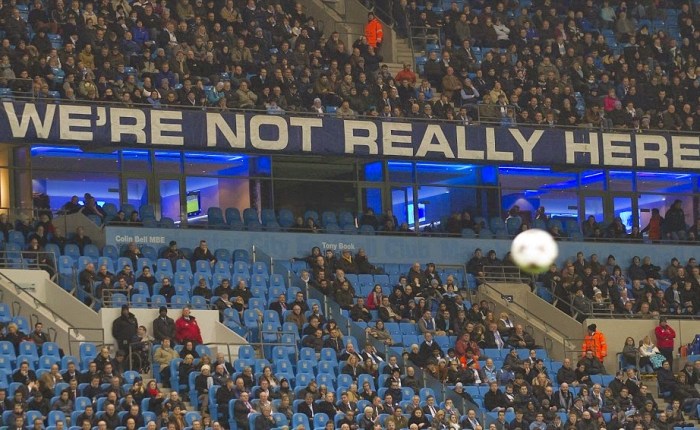
Much has been made in the aftermath of Roma’s visit to Manchester City about the number of empty seats at the Etihad Stadium. Lead by former Manchester United players, Ferdinand and Scholes, the atmosphere – or lack thereof – and City’s passion for European competition has been called to question. It’s easy to lead a charge of criticism, fuelled by sour grapes, when you conveniently ignore the overriding factors. The loyalty of City’s masses should not be doubted, the course of the modern game should.
First off the bat, I’m not here to make excuses for the poor attendance at the Etihad last night. It was disappointing. Normally when I write these articles I try (but probably fail sometimes) to keep my blue side suppressed and present an opinion based on the good of the game. Today, my opinion will understandably sound like it is coloured blue, the defence of the crowd last night has widespread issues serving as an undercurrent.
It’s all too easy to cast judgement over the lack of support and paint a picture that Manchester City fans care less or lack the passion of rival teams. It almost seems that the way to chip away at City’s rise to the top is to question if the people at the heart of the club – the fans – deserve to be there. I didn’t hear what the United old boys said last night, I was at the game and don’t record substandard broadcasts to watch when I get back from the ground. But I get the gist of it. From what I have read today, Scholes questioned why fans weren’t in the ground early. Well, we have City Square which provides entertainment before kickoff within our stadium complex. I’ll forgive him this oversight because there wasn’t room for such a thing when he worked at his outpost in Trafford Borough.

The low attendance has obviously been jumped on from all quarters. To tie this to the passion or dedication of City fans is absurd. I am fortunate enough to be able to afford a ticket to all home games in every competition. This doesn’t make me a better fan than a father of four on the minimum wage, struggling to make ends meet, who decides £35 for a ticket was a stretch too far when he could watch it for free on television. Remember, this is a club that kept its support in the third tier of English football, with an average attendance back then of 28,780.
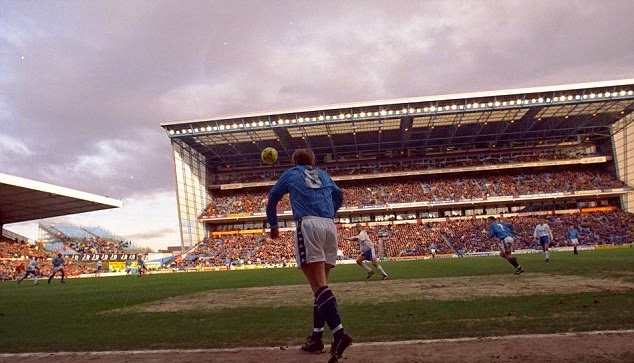
There is clearly a loyal core. City is new to the game of attracting global fans, new to the Champions League. With this is mind, they should be incomparable to Liverpool and United, yet, last night the clubs were slotted side-by-side to further demonstrate the low turnout. Years of worldwide exposure will gain any club the tourist fans, the glory seekers, the more fickle fans. In heavy numbers these fill empty seats. If City stay in the upper echelons of European football for the next decade these fans will migrate to the Etihad. That’s why the stadium is undergoing expansion – it is future proofing.
Scholes must also have a short-term memory. It wasn’t that long ago Manchester United only managed to fill 47,000 seats for a Champions League game against Cluj. Were the United fans not taking the competition seriously that year? The difference being, United sold a full allocation but fans still failed to travel. This brings us to another factor: United force season ticket holders to commit to Champions League games, City have a separate cup scheme.
This brings us to the main problem with the modern game. Cost. I have spoken out against FFP for a long time, and yet again I get the opportunity to here. Not that I take pleasure in doing so because this time it’s not to highlight how UEFA are attempting to protect the established big clubs. Unfortunately this anti-FFP observation is how the by-product of the unjust system affects the fans. Clubs are attempting to break even, the way they are accomplishing this is higher ticket and merchandise prices. Those empty seats at the Etihad were physical reminders that FFP is bad for the game on many levels.
Manchester City is the perfect club to place this issue in the spotlight. Unlike some teams, they aren’t run by debts or loans. Sheikh Mansour can pay for all wages and transfers upfront. FFP isn’t protecting a club like City from ‘doing a Leeds.’ FFP wouldn’t have even protected Leeds, they would have complied. It protects the European giants from being caught. But let’s say for a minute UEFA were genuinely worried solely about the rising costs within the game, if so, FFP was a weak attempt at a soft wage cap. They must have hoped clubs would, over time, lower wages to comply with the break-even rule. This hasn’t happened.
Since FFP’s introduction wages have continued to soar. Manchester United isn’t even playing in the Champions League and offer weekly wages in excess of £300,000. This leaves UEFA – if their intentions are genuine – with a few remaining options. The first would be to introduce a hard wage cap that all clubs across Europe adhere to. Observations would have to be made for certain areas (I.E. Teams in London can have a slightly higher one to counter the cost of living; Monaco, or teams in lower taxed countries like Spain, offer less so players can only take home the same amount after tax). Tied into this would be a new law on ticket prices. Just as clubs can’t offer high wages, they’d no longer be able justify high ticket prices.
The next would be to copy Baseball’s Rich Tax. I discussed this in the past (Financial Fair Prejudice) so won’t labour the point, but a similar method could be adopted in football. Instead of a set budget like baseball, we keep the break-even method, but when a team exceeds it they pay a tax as punishment on every penny over the limit. Rich clubs that have no debts could still operate safely. It would act as a deterrent rather than a way to stunt growth. Again, if a team is paying the rich tax it has no excuse for high ticket prices, the fans should be put first in the UEFA directive that would monitor the rich tax. In baseball the tax also increases for every cumulative year spent over the budget marker (or break-even in football’s case).
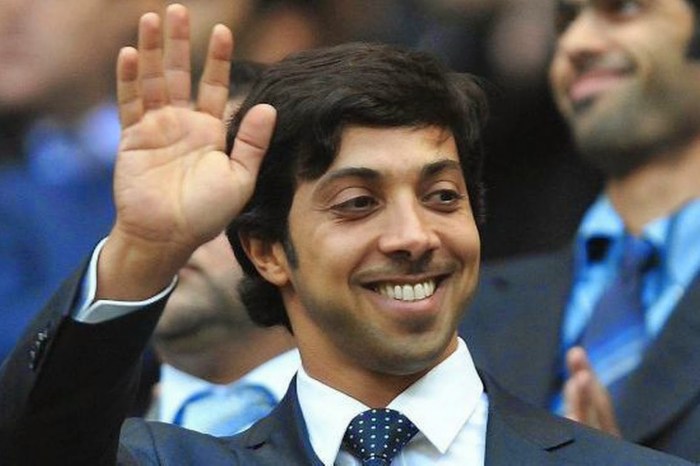
The final way to help fans would be the most direct and charitable method. As mentioned, Sheikh Mansour doesn’t need a dime from the City fans. He could comfortably pay for everything without needing to worry about his accountant. He has to charge the fans more to comply with Financial ‘Fair’ Play. His fines disappear to other European clubs who are also charging fans high prices to break-even. There should be flex in the break-even for ticket prices. Just as things like stadium expansion and youth development are left off the books for FFP purposes, there should also be an allowance to wipe losses when a club voluntarily charges less for tickets. City could sell tickets for £10, making it affordable again for the working class man, and sparing UEFA the blushes of empty stadia. If a generous owner can afford to invest at a loss, then is there a better way to do? Rather than higher wages to line the pockets of millionaire footballers, they could help make ends meet for the loyal masses.
It should be noted that in Germany they do offer cheaper tickets. It seems that here, the trend is to take from every source and ignore the fans. We have a product that commands high revenues but isn’t sustainable. Greed is dictating the game. Sky and BT fought and paid higher revenues for TV deals than ever seen before. The main reason was to wrestle control of the UK broadband market. However, I have been quoted as saying before: The value of something is only what someone is willing to pay. Whatever the motive, the price for TV deals has once again been set high. Perhaps UEFA, because we know they like to dictate, should place a rich tax on clubs that make more than a predetermined limit on such revenues. The tax would be paid by lower prices on the gates accordingly. Fine, take your Sky money, but it’d mean only being able to charge a tenner on match day.
Some of these suggestions would be legally difficult to implement. But when you think about it, FFP itself should have faced many more legal challenges but we now live by it. It seems what UEFA says, goes. It’s about time they did something to protect the fans from escalating prices. Without the fans, it’s really not a sport at all.

 The Reflective Page