F1’s Mexican Standoff

F1’s Mexican Standoff

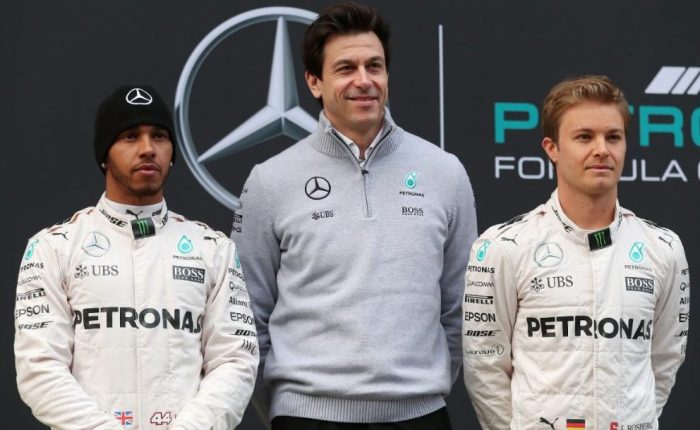
With three races to go on the Formula One calendar, the Drivers’ Championship hangs in the balance. Lewis Hamilton no longer controls his own destiny; Nico Rosberg doesn’t need to win again to clinch his first world title. In the background Mercedes holds its breath, acutely aware the tense relationship between the pair could fracture the team. Each of the three parties has a loaded gun pointed toward the one they deem weakest. Can there be a happy ending?

Toto Wolff has his pistol pointing at the talented British world champion. In any team sport an individual can never become more important than the group they represent. Wolff has been gifted reasons to come down on Lewis should he feel the need.

The Snapchat episode, and then Hamilton’s decision to leave the following press conference without taking a single question, add to moments that could be interpreted as unprofessional. The most telling is Lewis’s comments that a “higher power” was responsible for his continued reliability issues.

In hindsight, he probably regrets airing this concern in public. All it does is pave the way for more (ridiculous) conspiracy theories and is the slap in the face to those that work hard each weekend to give him the best chance of victory.

It does look bizarre only one driver using the Mercedes engine is victim of all the failures, especially when they are unique and do not follow a pattern. Nevertheless, it is still more likely to be coincidence than the team sabotaging results to ensure they have a German champion in a German branded car.

As hard as it will be for Lewis to hear, Toto will – in a roundabout way – remind him the Mercedes is the best car on the grid, that anyone would jump at a chance to be there because it’s the best chance to win a title. Wolff would be sad to see such a talented driver leave but if he did, there’s no reason to believe Mercedes would struggle win the Constructors’ Championship.

But the Austrian points the gun reluctantly. The best teams want the best drivers and Lewis still tops that list for most. A shot fired would be sent with a heavy heart.

Pointed at Wolff’s head is Nico’s pistol. This year he has defied perception. Ever since Lewis joined Mercedes it’s looked like the German has been in his pocket. It’s been said many times that Nico couldn’t compete wheel-to-wheel but the gap between them was more than this. Lewis had better pure speed, he gave the impression he had the ability to find a few more tenths when required while Nico was already at his performance ceiling.

From a psychological point-of-view, this eroded Rosberg’s ability. It was a vicious circle that the German appeared destined to repeat forever.

Then 2016 happened.

Bad luck finding Lewis may have provided impetus to Nico Rosberg, allowing him to amass an early championship lead, but it also allowed him to exorcise some demons. Even when Lewis started his fight back, this new Rosberg didn’t fold. With every passing race, he’s gone from a man in Lewis’s shadow to a man looking like a worthy world champion.

If Lewis does create disharmony within the team, Nico can politely point out he had to suck it up when the Brit was taking titles and that he’d expect nothing less than the same support. The team couldn’t offload their new German world champion who has impeccable conduct, in favour of a guy with a chequered history when it comes to behaviour.

Which leaves Lewis Hamilton: the man with two guns.

The first of those is firmly aimed at his teammate. He can’t fire him from the team but he can break his spirit to such an extent that Mercedes no longer rate him worthy of a drive. When Rosberg outperformed Michael Schumacher, then team boss Ross Brawn commented that Nico could be the fastest man on the grid, implying Schumacher’s performance was still of a high standard.

There is now weight to that remark. Given the best car, Rosberg has held his own with Hamilton. Given some confidence, he stands on the cusp of a world title. It’s the type of belief he displayed after getting results against the old master and legend, Michael Schumacher.

But Hamilton has had the privilege of a better car and scoring the first world title on its behalf. This has given him the upper hand. Their history goes back to childhood and one wonders if there’s some hold Lewis has over Rosberg that the German can’t shake. Every time Nico matches Lewis, the Brit finds another level. A win in Austin and now a pole in Mexico, the doubts must be creeping into Rosberg’s mind.

To be within touching distance of the title and have it snatched would cement the mental edge Hamilton has over Rosberg.

But it’s the gun Lewis holds in his other hand that should be the real concern. It isn’t pointed at the towering Toto Wolff – it’s pressed beneath his own chin.

Despite the impression he can mentally break Rosberg, the person he causes most psychological damage to is himself. He’s a guy that wears his heart on his sleeve but far too often likes to write his own narrative. The early season party lifestyle was moulded into some character transition. That the flying Lewis needed to let his hair down to focus best on the track.

But the truth is, when the going is good it doesn’t matter what Hamilton is doing on or away from the circuit. The problems begin when he starts to write dark chapters instead of taking a step back from the circus.

He has showed cracks in the past, most notably when Button got the better of him as teammate. We saw then, as we have again this season, the exuberant Lewis become a moody, withdrawn, petulant impression of a teenager.

But he’s thirty-one years of age and should be setting an example as a world champion when off the track. Bad winners are worse than bad losers, Lewis is displaying traits of both.

Should Nico Rosberg win the title, Lewis has claimed he’ll, “take it like a man,” which begs the question: why hasn’t he managed to so far? If he did jump from the team, there would be nowhere to go following Mercedes of any worth. He’d become the next Fernando Alonso. A great driver, destined to struggle in second-rate cars.

None of the gunslingers can be confident of what the future holds but all three can be certain of one thing: they’ll be more losers than winners.
The Exorcist

The Exorcist

The start of a Halloween weekend sees many turn to their movie collection to dig out the best fright-fests. This invariably leads to discussion that asks the big question: What is the scariest film ever?

The answer from these quarters: The Exorcist.

As firm as that answer will always be, so is the chance it’ll find disagreement. Since its release in 1973, the horror genre has gone through many reinventions in order to maintain appeal. The search for shocks, of the jumpy kind or those that push the boundaries of what is acceptable to show on film, means the psychological chills have seen less usage.

Sure, The Exorcist wasn’t averse to special effects designed purely for a gasp, and to test the viewer’s constitution, but it’s credit to its real scares along the way that these still stand-up. Admittedly some have lost their immediate power after years of being parodied, either on purpose by the likes of French and Saunders, or by cheap copy-cat horror productions looking to recreate some of the magic.

Those untouched by the movie are the ones most likely to dispute the existence of life after death. But if you spend your days praying to a force for universal good – or just believe there might be something after death – then playing with the notion of a bad side becomes unsettling.

The build to the evil emerging is a deliberate slow step. In the opening scenes we witness Father Merrin unearth a token in Iraq, signalling a demon has returned. This backstory is developed in other media, here we just get a hint and he later alludes to it himself.

A skip to Georgetown and we are introduced to the life of famous actress Chris MacNeil (played by Ellen Burstyn) and her daughter Regan. What is most remarkable about Linda Blair’s performance of the twelve-year-old is that any evidence of over-acting can only be found in the pre-possession scenes. Before the demon is inside her, the acting is cringe worthy. But once she is asked to perform as a possessed human, it’s far too believable.

The seemingly innocuous occurrences ramp-up until Regan herself displays changes in behaviour. Being famous comes with suspicion. It’s conceivable a daughter exposed to the Hollywood lifestyle would have a sense of theatrics. When Chris seeks help from local priest Father Doctor Damien Karras (double titled to highlight he is also a psychiatrist), he even asks if Regan could have accessed recreational drugs.

The Father is assured that hasn’t occurred. What let the demon in was Regan playing with a Ouija board. But the case comes at a time he has lost his faith in God. This morphs once he begins to believe Regan could be possessed for real and it’s not a disorder, fake or a result of being exposed to drugs or a situation.

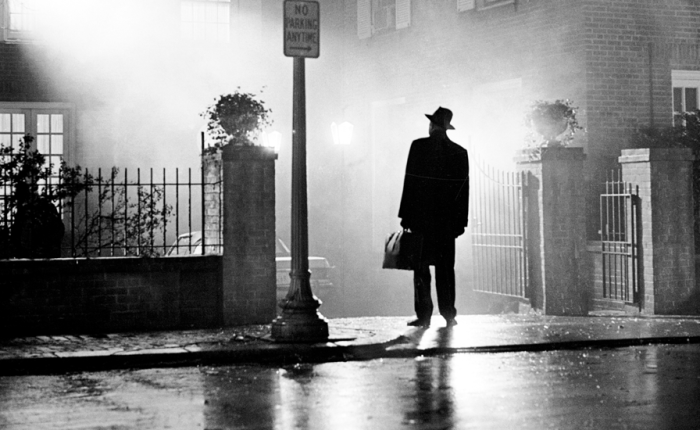
He calls in Father Merrin for assistance. The shot of Max von Sydow’s Merrin arriving on a dense, murky, atmosphere filled night is beyond iconic. If a sense of a character and his importance to a film has ever been better captured then that footage must be missing: This is the pinnacle of achieving such a feat.

Merrin brings great advice (“But he [the demon] will also mix lies with the truth to attack us.”) and prior experience. And soon begins a battle between good and evil, to a suspense filled climax.

It may sound an over-the-top reaction now, but upon its release stories of nuns sprinkling Holy Water as people stood in the queue to watch the film, added to its notoriety. It’s the sort of marketing campaign movie execs wouldn’t dare dream up. Such was its impact, those that saw it, understood why. In England, St John’s Ambulance had extra staff on standby as people passed out when confronted with the images.

Its 1998 re-release in the UK is when this writer appreciated those concerns from the seventies. Undiminished by time, it was equally as shocking and thought provoking.

By the time the famous head-spinning scene arrives, you are absorbed and truly believe the young girl is possessed, the words that follow, “Do you know what she did? Your cunting daughter?” are chilling. Far from the potential comical, dated look it should have had two decades after being made.

Remarkably, when adjusted for inflation it is the highest grossing film Warner Bros. has ever released. It explains why they were quick to call for a sequel but makes one wonder why the successful formula was abandoned. More surprising is how no movie maker has ever gotten close to replicating the style.

Usually when a movie gets rated number one in a genre, it is revisited on a fairly regular basis. The Exorcist is the exception to this rule. Even though it’s a horror movie and this is Halloween season (and the eagle-eyed viewer will note the story takes place over Halloween) it’s not one I’ll be revisiting any time soon.

After seeing it in the cinema during its 1998 run, three weeks of nightmares followed. A little older now, after a viewing this can be reduced to three uneasy nights.

Until such a time the demon can be faced once again, the aim is to try and enjoy “Tubular Bells” as nothing more than a piece of music, not associate it as the perfect soundtrack to the perfect horror movie.

Premature Pep Talks

Premature Pep Talks

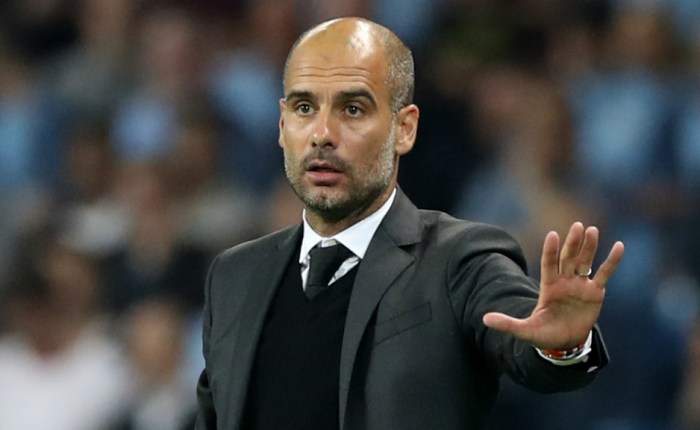
Ever since Pep Guardiola arrived at Manchester City he has been subjected to an unprecedented degree of inspection and expectation. Understanding the negative impact this could have, Pep has been the voice of reason. When City started the season with a run of ten wins, he spoke to closed ears when attempting to explain it wasn’t a true indication of the team’s current level. Now with a dip in form, he once again faces ignorance from a media determined to undermine Europe’s most successful manager.

Suddenly there is no shortage of experts offering advice to the Spaniard. Pundits that occupy seats in the safety of studios, or journalists who have to service the wants of fans from opposing clubs (the clickbait brigade), are suggesting that his proven methods will never work in the Premier League. That before we’ve even entered November, it’s time to admit the English way is unique and his crazy ideas have been shown up for what they are.

Not satisfied with telling a man – who was happy to point out in Friday’s press conference he’s won twenty-one titles with his ideals – his tactics are wrong, they are also attempting to forge wishful transfer rumours into facts. He was happy to point out where they are incorrect.

Beneath the obvious, are more subtle claims. These are just as easy to dispel. The most erroneous is that in principal he is no different to predecessor Manuel Pellegrini. For those that found that amusing (as any serious person should), take a second to let the giggles pass.

The notion comes from the half-baked view Pep and Pellers both shared a common denominator: They have one way and no Plan B.

This was clearly a case that could be mounted against Pellegrini. Like Roberto Martínez, it seemed they’d rather lose playing their way then adapt to opponents and unique situations. They refused to be proactive, instead soldiering on, expecting different outcomes with faltering systems.

Pep is different, and certainly not a one-plan man.

The ethos – his religious view on how the game should be played – will remain consistent, but within the framework changes are made. Whether it’s switching to three at the back or an extra man in midfield at the expense of a striker. There was always a rigidity with Pellegrini (even with formation changes) that isn’t evident with Pep. A tailored approach after examining the opposition has replaced blind optimism, or should that be: plain stubbornness.

When those able to acknowledge Pep has adaptability, they cover it by saying he should slowly implement his ideas and until then play to the strengths of the current squad. It can’t be argued that the best managers go in and work out where strengths are and chop the weaknesses. But isn’t that what he’s done already with the brutal treatment of players like Joe Hart and exclusion of Yaya Touré?

It’s only managers who are survival experts, like Sam Allardyce, that allow personnel to dictate shape and style. There’s a reason veterans of the managerial game have never featured in the Champions League while Pep has won it two times.

It is always a results based business – Roberto Martínez would have done well to remember this – but to take the silverware, become an all-time great, you need to have ideals that can be transposed across a spectrum of tactical problems.

He’ll accommodate players where possible but ultimately they bend to his will: his ethos can’t change for theirs.

Unlike Pellegrini, who it seemed sent players out with vague instruction, Pep makes it clear what he expects to see. When his system fails it’s obvious where individuals have been lacking. This accountability makes it easy to root out weaknesses and build the correct team. That process is now underway following the passing of the honeymoon period.

Players are beginning to show their true colours. Some are just unsuitable for the demands Pep is making. Others, through either poor work ethic, attitude, or time of life, cannot perform to the required standard. Pellegrini may have ignored their shortfalls, Pep will not.

Guardiola also knows football tactics are constantly evolving, it’s why he came to City. This opportunity is the continuation of his education. There’s no suggestion he’ll plough on with failing tactics but he’s confident the overriding ethos works.

People shouldn’t complain when José Mourinho parks the bus because it’s boring, they should question why he’s still rolling out tactics from yesteryear. Pep’s dynamic approach makes even the Portuguese United boss look like a tactical dinosaur.

But members of the “Red Press” would rather highlight Pep’s perceived failures, that are nothing more than growing pains, and ignore how the Special One has become the Stagnant One.

They also believe his tactics have been worked out. That Celtic somehow exposed the key to the conundrum when they only replicated what Swansea had attempted. Pep would rub his hands at the prospect of every team pressing City every game until the end of the season. If his system is implemented correctly, they’d be making the space for him in vital areas of the pitch.

But it’s easier to pretend after years of success, the brutal nature of the Premier League has cracked the Guardiola code. It’s as if he was the Illuminati and Brendan Rodgers formed some part of a Da Vinci Code, that the Tom Hanks looking Premier League managed to work out in time to prevent an embarrassing runaway success.

Thankfully people like Robbie Savage have sound advice. The man that only adorns the BBC because his dress sense brightens up the dreary looking Phil Neville, and his mindless enthusiasm on commentary offsets the drier tones of Mark Lawrenson, believes Pep isn’t a tactical genius after all. Robert Langdon – sorry, the Premier League – has seen to that.

Nor does Pep need to reinvent the wheel to conquer Europe with City, just fix its punctures.

And that’s the problem: Pellegrini didn’t leave Guardiola with a working wheel. It was a shiny cart with its components used for forward motion removed, instead sat upon shaky bricks and an instruction manual that had been left out in the rain. City didn’t need tweaking, they required revolutionary treatment.

There is no one better in the game to provide this than Pep Guardiola.

Like any revolution, it will take time. Those that have faith will be patient, those with hope it fails will fabricate stories and print insincere views to upset the steady progress.

Pep doesn’t need to change his ethos; he just needs to realise in the land of Premier League football, freedom of speech means the nonsensical have the loudest voices. But empty vessels do make the most noise…