Accrington Stanley, Who Are They?

Accrington Stanley, Who Are They?

A catchphrase made famous from a milk advert before the Premier League existed, and best sums up attitudes displayed by that organisation this week. Accrington Stanley’s chairman, Andy Holt, attempted to highlight how life in the lower leagues was a struggle while those in the top flight lived in luxury. The response: a veiled threat to remove all financial support for Stanley and the other members of the EFL.

Mr Holt also suggested in this tweet, that the Premier League was a destructive force:

To begin with, let’s deal with an insinuation the Premier League levelled at Andy Holt. Since the new TV deal (with oversea rights, this now exceeds £8bn) the Premier League upped its contribution to the EFL and grassroots football by 40% to £1bn. Okay, that sounds a very large figure but it needs be placed into context.

The increase in TV revenue was 70%, so already there is a disproportionate redistribution of money. On the bottom line, the Premier League donates a smaller – albeit larger final sum – percentage of its revenue to those below them in the nation’s football pyramid.

Of that £1bn “donation,” the majority of it actually goes to teams relegated from the Premier League in the form of parachute payments. Suddenly that large cake on the table has a big chunk missing.

Before the deal, 3% went to grassroots, now the twenty clubs in the top flight agree to invest £112m a year into this programme. Again, context is required here. Grassroots is a place the top clubs circle like predatory sharks without fronting the sizeable bill. Between them they can just about muster £112m when Manchester United alone are willing to give an agent £41m for a single transfer.

This is where Andy Holt’s fears about the state of football hold the most water. Top clubs are able – and have no qualms – to allow money to leak from the game. Just as boxing promoters act as vampires on the sport, financially benefiting from the skill of others as the grassroots decay, football agents walk away with money that could prop-up entire divisions.

With the best fiscal management in the world, the harsh reality for lower league clubs is a yearly battle with rising costs and increasing debts.

The Premier League has gone past the tipping point when it comes to moral obligations. The desire to be the NFL of soccer has made it lose sight of certain facts. The NFL model works because there is nothing beneath it other than college football.

By the time the Premier League is finished, there won’t even be suitable football training in our schools. They have allowed a cancer to enter the revenue stream of the beautiful game and failure to ignore the final cries for help from people like Andy Holt, is like refusing lifesaving treatment.

Such is the arrogance and disconnect with the real world, the Premier League thought ensuring all staff members at top flight clubs were on the minimum living wage was a show of grace. It was the absolute least expected.

It has made no efforts to control ticketing prices for fans, meaning the working-class man in the terraces hasn’t seen the benefit of increased revenue passed down to him.

Too many clubs in the EFL, like Leeds, Blackburn, Nottingham Forest, cripple under their own weight as they take massive infrastructure into a landscape that can’t provide. It’s a wonder teams haven’t already started dropping out of existence. But that day will come, and it will affect the big and the small in the EFL, because they all have one thing in common: they have been made to sit on the poor table.

The tone of the Premier League’s reply gives the impression they enjoy teams coming to them like Oliver, bowl in hand, begging for more.

The Premier League has forgotten that the football pyramid in this country used to be a symbiotic relationship. That’s what the FA Cup used to symbolise: all ninety-six professional teams and all the non-league ones below that enter, on a level playing field of equal importance.

Nowadays the notion is played with by the Premier League in the same way a cat toys with a dead mouse. The idea of a shared national game is just a novelty to those at Lancaster Gate. They’re not bothered about Andy Holt’s opinions on the matter because they’re not bothered about the EFL, grassroots, or Accrington Stanley.

Who are they?

Exactly.
 

Time for Arsène to Go

Time for Arsène to Go

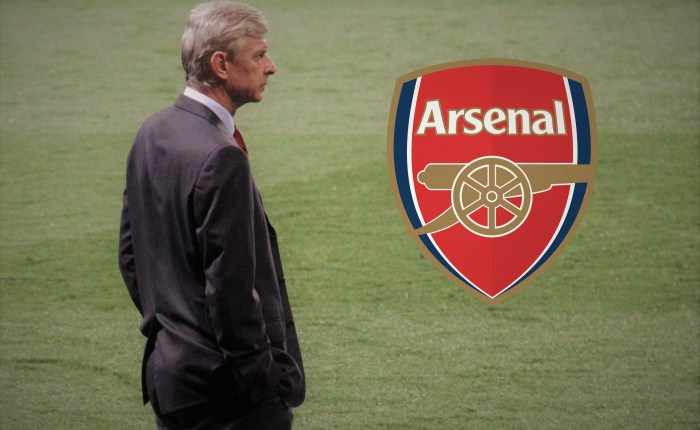
The indignity of an overhead plane calling for your removal is a moment no manager can survive. While it raises questions about the class of fan that arranges such a display, it is a clear watershed moment. Arsène Wenger wasn’t the first to befall this treatment, but he is the latest and it means bridges can never be rebuilt with a large section of the Gunners’ support. Before the situation declines further, he should do the most logical thing: announce this is his last season at The Emirates.

If only it was so clear cut. Wenger is an open book. His achievements during his time in North London are as obvious as his weaknesses. The main hindrance now being his stubborn nature. It’s that single purpose and drive that once made his Arsenal side become Invincibles. But that was a long time ago – a different era, even. His way is no longer the way. With each passing season when he digs in, Arsenal fall further behind.

His presumed principles should be applauded. On the surface he is against the modern way of buying success. He’d rather develop players. A by-product of this has been the club’s ability to quickly payoff the outstanding loans on their new stadium.

For a while, a new stadium – bought and paid for – was enough to satisfy the supporters. It was always accepted with the understanding once it was paid off, they’d once again compete in the transfer market. Well, the bricks and mortar no longer require financial nurturing but the team does. And Wenger refuses to budge.

What is baffling, is how the stance on transfers is broken now and again (Mesut Özil £42.5m; Alexis Sánchez £35m; Shkodran Mustafi £35m; Granit Xhaka £34m) without an air of caution or appreciation for market value. Still, a feeling persists they are two or three players short of a title winning team. The problem is, they’ve been short for years now.

ozil snachez

Not to take anything away from Leicester’s achievement last season, but that was Arsenal’s best chance to put a decade of being happy with top four, and title nearly rans, behind them. Chelsea were recovering from a Mourinho meltdown, Manchester City had a long, painful goodbye with Pellegrini, Manchester United and Liverpool were still missing in action.

Their local rivals, Tottenham Hotspur, showed they lack experience and maturity when it comes to leading the pack, eventually finishing below The Gunners. It was a case of “now or never.” Arsène’s players opted for the never.

And no matter how long he clings onto power, further success will continue to elude him at The Emirates.

FA Cup victories are not sufficient. Top four finishes – as lucrative as they are – are not satisfying. Success in Europe is, but that’s gone for another year. A Premier League title is, but even in the unlikely event Chelsea implode, other teams will be more likely to capitalise.

The truth is, players and fans alike no longer believe in the Frenchman. It is sad to see such a great record at Arsenal be bookended by disharmony and a lack of respect. But he has to realise his continued presence is having a negative effect as the club try to evolve.

Outsiders will never know if Wenger is carrying the can for the board. They say he has money, but behind closed doors the story could be much different, with his professionalism forcing him to tell the press a skewed version of events. There must have been pressure on Wenger from above because when they moved stadium in 2006, and up to 2013, they actually turned in a profit of £40m in the transfer market.

Had his ideology always been to spend less, develop more, why hadn’t Arsenal turned in a stadium-sized profit every season before this?

Historically, he was happy to bring in imports that required a final stage of development. The team that went unbeaten all season during the 2003/04 campaign added José Antonio Reyes in the second transfer window for £13m. That’s about £18m adjusted for inflation, which doesn’t take into account the new TV money and modern day premium on Premier League transfers.

Could you imagine Wenger sprinkling a player short of £20m on his squad in January nowadays? It’s less likely than when his team hadn’t lost a single league match.

Reyes was the final cog that had followed a series of highly priced acquisitions. The list reads something like this: Marc Overmars £7m; Patrick Vieira and Freddie Ljungberg £3m; Kanu £4.5m; Sylvinho £4m; Thierry Henry £10.5m; Lauren £7m; Robert Pires £6m; Sylvain Wiltord £13m; Francis Jeffers £8m; Edu £6m; Giovanni Van Bronckhorst £8.5m; Richard Wright £6m; Gilberto Silva £4.5m.

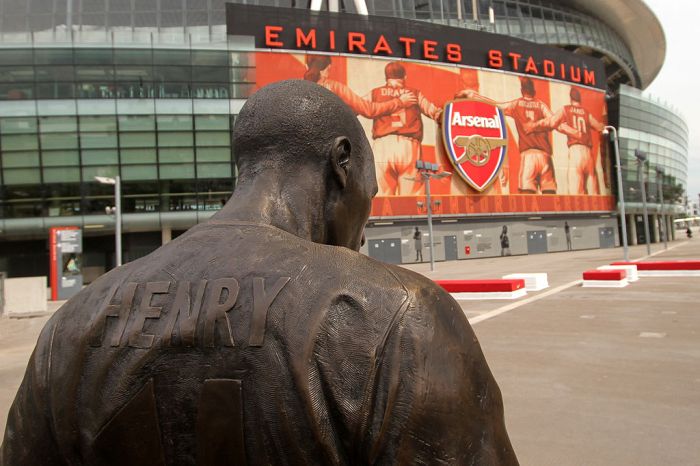
Thierry Henry

Those are just the most eye-catching (not adjusted for inflation) from the summer of 1997 to 2002, they are punctuated with many more that exceed millions and offer sparse evidence that Wenger has treated his time at Arsenal as a place to develop cheaper players.

When it suited, he spent big. It’s hard to believe he had a paradigm shift in attitude, unless he’s an all-out hypocrite. But even these big names moved on to pastures new, including golden boy Theirry Henry.

Since then the state of domestic leagues has changed. The Premier League has more cash but foreign top flights have the wealth of better players. The time to develop unproven talent is forever diminishing. To make matters worse, his record with young talent reads very poor.

Has Theo Walcott improved that much under Wenger? He’s one of many young players that have stagnated under him rather than reach full potential.

His methods are antiquated, his views romantic but out of date. One more season isn’t going to bring about the change he’s struggled to find in the last ten years.

The Arsenal fans should be eternally grateful to Wenger, likewise, he should acknowledge that those buying the most expensive seats in the Premier League deserve a fresh direction.

Ranieri Reign Makes Case for Manager Rules Review

Ranieri Reign Makes Case for Manager Rules Review

Claudio Ranieri – the man responsible for taking Leicester City to dreamland – was brought crashing back to reality with the ruthless nature of the Premier League once again being displayed by a twitchy chairman. He becomes the fifth top flight manager to leave his post this campaign, and the fourth out of the last five to win the title only to be axed the following season. The time to analyse each individual case on its merits has passed – if Ranieri can be sacked, there is no measure of safety to consider – it’s time to question the staff system as a whole.

Before offering an alternative to the current way of life for football managers, it’s worth noting every club making a change has clear (if cold) reasons for doing so. Swansea believed Bob Bradley was in a sink or swim scenario with his lack of Premier League experience and showed no signs of doing even a doggy paddle.

Mike Phelan on the other hand, had shown signs of improvement at Hull City. His seemed a thankless task: a small squad, no money, an eleventh-hour appointment. Despite the cards being stacked against him, he soldiered on. That aforementioned improvement didn’t translate into the only element club owners care about when faced with relegation: points.

That’s why Crystal Palace replaced Alan Pardew with Sam Allardyce. The former went on long runs without collecting many, the latter almost guarantees survival.

It’s the fear of not surviving that prompted Vichai Srivaddhanaprabha to wield the axe at Leicester. (Yes, the chairman’s name was copy and pasted.)

It’s the players at the King Power who should be taking ownership of a change in their application and work ethic. It’s clear to see their interest levels have only peaked in the Champions League. They used player power, regardless of what Craig Shakespeare says in press conferences, to avoid taking direct responsibility for their attitude and performance.

Ironically, the man favourite to replace Claudio Ranieri – Roberto Mancini – left Manchester City for the same reason.

He lost that dressing room and Manchester City hired a pussy cat. The Foxes have gone the opposite way, fired Mr Nice Guy and hired a disciplinarian. Makes sense when people need whipping into shape but the players who lacked professionalism will rue the day they got a good man fired.

All these managers needed the same thing: Time.

The panic of losing Premier League status, and all its rich financial rewards, has chairman all too eager to press the panic button. The League Managers Association (LMA) have a thankless task. They have no negotiating power in the boardroom and can only transition managers into the job market. The chance of them ever taking a big club to tribunal is on the same scale as it was for Leicester to retain the title and win the Champions League this season.

If the managers and the LMA can’t enable a fairer work place, who can?

Well, it has to come from the top. It would require UEFA to make it law or for the Premier League to take a bold step and make rules for clubs on these shores that would remove the equal playing field they currently enjoy with the rest of Europe.

And while this sounds outlandish at first, it’s worth remembering the Premier League has set out to differentiate itself from its European equivalents. The new branding seen this year, without the need for a sponsor, was an effort to make the Premier League a global symbol like the NFL or NBA.

It’s from those American counterparts they could take inspiration.

Before we get to their methods, there is already a system in place that could afford managers protection: the players’ transfer window. Seen as an awkward disruption nowadays (ask a West Ham fan about Dimitri Payet) and a way for clubs to inflate prices, it does offer one thing to players – a settled block period without the threat of being moved on.

Of course, a club can fire a player by releasing him from his contract, but they see the financial loss as too great to ever do this. Unless the player involved is Joey Barton. This gives players a fighting chance to prove themselves. And when the writing is on the wall, at least they have time to prepare and fashion a deal with their agent for a new club.

The modern day manager goes week-to-week – sometimes day-to-day – with the threat of the chop in the background. If they were afforded the same protection by only being removable during the player transfer window, clubs would have to show the same commitment they gave on day one of the manager’s reign.

Maybe it would only result in the January transfer window becoming a crazy merry-go-round of players and managers, but there’s also a chance clubs would buckle in for the season. Clubs that still felt the need to part ways when relegation loomed would only be able to promote from within, giving backroom staff a chance and some form of continuity.

But maybe the Americans have got it correct. In NFL, coaches are fired on the first day of the regular season. It’s known as Black Monday and several sackings is seen as harsh. A regular debate within NFL is whether firing bosses actually improves results. They still make changes during the regular season but across American sports it’s not as prevalent as it is in football.

So, what if there was no transfer window for managers in football because clubs couldn’t replace a Head Coach with an external appointment at any point in the season?

It would ensure clubs got behind their managers 100%. They’d have to make it work. The time, and undue pressure a lack of it brings, would be afforded to coaches often struggling against resistant waters. Some players don’t like a new ethos or coaching methods and in today’s football world, they know all the power lies with them.

If a chairman had to retain his manager, that power would swing back to where it should be: with the boss.

These ideas are the extreme end of the spectrum but the results they offer would please fans and clubs alike. Currently agents have more influence than the people that work long hours coaching teams and preparing for matches. A safety net and legal assurances for managerial staff would reduce this ugly side-effect of today’s game.

It seems far-flung right now, but everything has a breaking point. If the Premier League carries on its current trajectory, it will buckle under its own weight. The manager sack race is just another indication football is in silly season.

It’s time for calmer heads to prevail, and loyalty and respect to have more bearing than the potential of a few short-term victories to snatch the pound signs flying around.