Tomorrow Becomes Yesterday

Tomorrow Becomes Yesterday

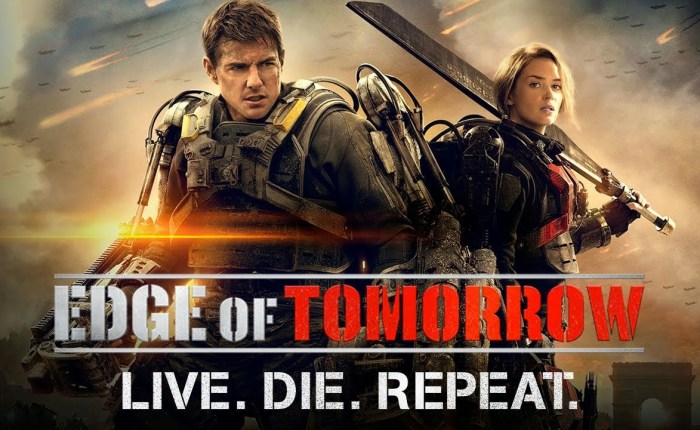
From the tagline: Live Die Repeat, and a sneak at the synopsis or a trailer, we know that Tom Cruise’s latest offering is a Groundhog Day with guns. We also see that, just like Oblivion before it, it is set in the world of science fiction. Tom Cruise is the last genuine Hollywood star, in the sense, he believes his name alone can bring box office success, rather than relying on a famous or established franchise. Yet, recent figures show is star, at least in North America, could be fading. Edge of Tomorrow attempts to repeat his former glories.

It is hard to distinguish Cruise’s modern set of films in traditional terms. The movie makers would argue that the global markets play a larger role than yesteryear. That not breaking even at home doesn’t matter when foreign totals smash the production budget. And it seems that outside of North America the Tom Cruise product is still very strong. What makes receipts over personal popularity incomparable across markets is the way different cultures absorb trends. Whether some parts of the world still adore Tom the same, or if they’re more likely to listen to positive reviews from critics, is hard to ascertain.

What we can determine is that Edge of Tomorrow promised an intriguing idea. Why it failed to garner more attention in America is a puzzle to me. Perhaps some were concerned after the lukewarm response to Oblivion (a film I quite liked). Once buckled into the film, after twenty minutes have passed, it’s clear the intriguing idea is being delivered into a top quality film.

It could have been so easy to fall into action film clichés, played it safe or worse still, played it lazy, but Edge of Tomorrow never does this. It feels authentic, like it’s aware and confident of the feel and direction it wishes to take. It harks back to action films from the 80s that set genre defining tones. Sure, it nods its head to things that have passed before; however, it only does this because sometimes those ingredients are required.

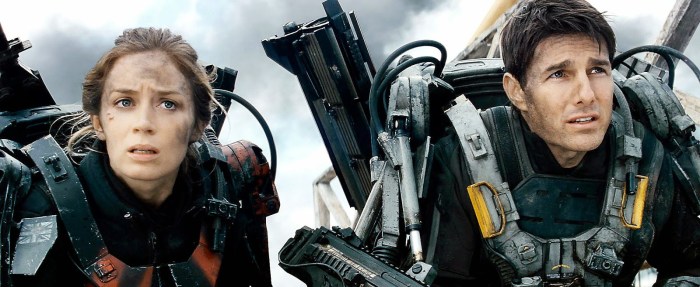
Also, make no mistake: it is packed with action scenes. Unlike most modern action flicks these aren’t there as filler. Like Aliens, a benchmark for all shoot-em-up films, the action belongs. It is never there for the sake of it until we get to the next scene with dialogue. Indeed, this story requires the repetition of action scenes, it’s what drives Cruise’s character, Major William Cage, along. The characters do develop, too. And unlike regular modern films in this genre, we are offered subtleties over spoon-fed emotions and progression. Discreet lines pass between Cruise and Emily Blunt’s female lead that never get the spelled-out, typical Hollywood, resolution. We just know it was there.
Blunt Cruise

Certain design aspects pay homage to what has gone before. The combat suit springs to mind. That particular piece of kit also could remind a person of video games, Halo isn’t a million miles away. It’s fitting that a video game gets a mention; they operate on characters “re-spawning” to rejoin the action, not unlike this movie. Also, the author admitted to using video games as an inspiration as he completed the story.

Don’t allow this comparison to fool you or degrade the vision of the movie, it’s not a simple run-through of a film. Okay, it’s not complex either; it just has that correct feel. It is solid storytelling combined with valid action, as opposed to over the top CGI and words that mean nothing.

While it is easy to criticise Tom Cruise for chasing a legacy as the leading superstar over deep, challenging roles (Born on the Fourth of July was way back in 1989, there were only a few roles with depth in the 90s, nothing since), if he seeks out this sort of popular film his talent isn’t totally wasted.

Could the ending be better? Perhaps? But one feels this film is all about the journey, not the destination. And thankfully for Tom, he’s waking up in a tomorrow where he still can command top billing whilst distancing himself from the slips of recent yesterdays.


Cruise Top Gun

More Than Just Flesh

More Than Just Flesh

When I first read Michael Faber’s excellent novel Under the Skin, I made a beeline for what was then his newest release, The Crimson Petal and the White. The two couldn’t have been much more different but both had the hallmarks of a great writer. Whilst reading the former I often wondered what a great film it’d make. Fourteen years on that is a reality, thanks to a Scarlett Johansson flick. But is it another case of the novel being infinitely better than the big-screen attempt?

The book was a tense and teasing affair in which the female protagonist was slowly revealed page-by-page as her motives and emotions started to unravel. The big reveal took a fairly long time to come around, and by then Faber had you in his hands as he went toward the dark finale. I’m glad to report the movie manages to encapsulate the sense of tension equally well; however, it aims for a different path. From the start it’s obvious that Johansson’s character is alien to this world. Everything that unfolds does so with the feel of a cagey, dark sci-fi. The pace that it approaches the subject matter will divide opinion, much like the movie itself has.

One thing for sure is how good Scarlett Johansson portrays so much, using so little in the way of scripted dialogue. In the novel we had her character’s perspective fed to us along with a back-story that served as a way to offer empathy. Here we rely purely on the actress’s ability to convey all the unspoken, but highly important, character developments. Thankfully she is more than up to the task, displaying a master class that will sadly go unnoticed.

The story does take a different turn than the book, the fact it will is evident early on, but this only serves to enhance the mood and the lead’s performance. Before it has the chance to lag under its own tension we are served a chilling end, not the sort Faber gave us but by the final scenes this had become very much its own beast. So not a case of the book being better, just different. Quite fitting when both the novel and movie challenge us to explore differences and perceptions.

Staying Out Of Trouble

Staying Out Of Trouble

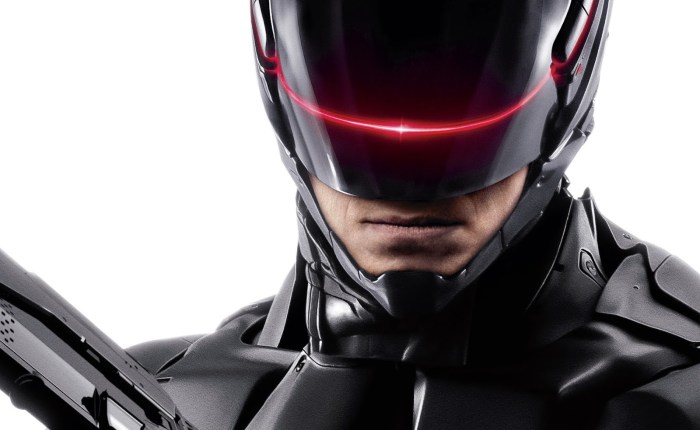
Reboots, remakes, recycling old ideas for cash, however you want to put it, Hollywood loves bringing back movies from yesteryear and milking a familiar cash cow. The latest character to get the treatment is Robocop. There was collective sigh asking “why” when the remake was first announced, followed by constant interest. Leaked photos of the new look Robo followed, accompanied with details about plot and on-set action. Forums were alight. The reason: Robocop does deserve a successful franchise. We never complain when Batman gets reshaped, next time around the Dark Knight’s absence will amount to only several years, and Robocop is an identifiable legend too.

That reasoning aside, some people are opposed a new flick because of the old classic line: It won’t be as good as the original. More often than not that statement is true for all remakes/reboots/reimaginings. The new Total Recall made me want to dream it away, and that movie was the tip of the rehash iceberg. So going into the new Robocop one should make peace with the idea that it won’t be as good as Paul Verhoeven’s original (but can’t be any worse than Robocop 3). After this has been accepted then we can judge why this is so in a more positive light.

First off a look at the age rating shows the studio’s intentions, dropping the 18 cert for a wider audience was a financial choice. In itself this needn’t be to the movie’s detriment, intelligent films don’t need blood and guts. So while there’ll be nobody asking, “Does it hurt? Does it hurt?” the sad truth is it starts to hurt the movie in unseen ways. If after stripping away the graphic violence you reveal a product posing less IQ than the predecessor, problems arise. Of course these are hidden by modern polish but the transition from the original’s dystopia to the new franchise’s gloss makes you wonder where the soul is. Remaining positive, I’d say there is one there, but it’s less certain than the classic.

It’s simple to say what doesn’t work. Without giving any plot away it lacks the satire of the Verhoeven’s, yet somehow tries to address this with Samuel L. Jackson’s character. This amounts to a bad impersonation, like watching Elvis live one night then visiting a bad karaoke the next. By trying to pay homage to the original it losses the point on why it worked first time around. The ideas around capitalism, distraction, greed from the first were natural political observations of the time – still valid now. Padilha, director of the remake, has his own points to raise and should have stuck firmly to them. By trying to absorb the sense of the original his head is nodding everywhere but finding a message nowhere. Because of this the humanity of Murphy is lost, which is a sin considering this version has Joel Kinnaman more man than machine (psychologically) after his accident, whereas Peter Weller’s Robocop undertook a journey to regain his human side.

Where it lacks the grit and realism of the first it does come across as a complete and well-thought-out film. In many ways we’ve surpassed the fictional technology presented first time around and yet this movie still feels fresh, even incorporating new ideas to aid our hero. After a viewing nobody could claim it’s been cobbled together for a quick buck; they do care about this brand. They’ve just dumbed it down for the masses, even the fourth directive now comes as a visual aid.

If sequels appear they may find the comparisons to the 1984 movie cease and the groundwork laid here will start to pay off. The only welcoming leftover at that point would be the theme music, which I was happy to hear after all these years. With a production budget of $100M already surpassed by box office totals of $146M it’s possible we’ll get those sequels. With Gary Oldman attached they stand a good chance of success, both with his undeniable ability and his record of being the highest box-office earner in terms of franchises he’s connected to.

Overall you’ll come away from the 2014 Robocop thinking it’s actually okay, not as good as the original – but you already knew that. There’s no one asking Bobby if he can fly, no cool names like Clarence Boddicker, no acute observations on class warfare, media or consumerism, but it is a healthy new take that revives a franchise – something not many reboots can say.