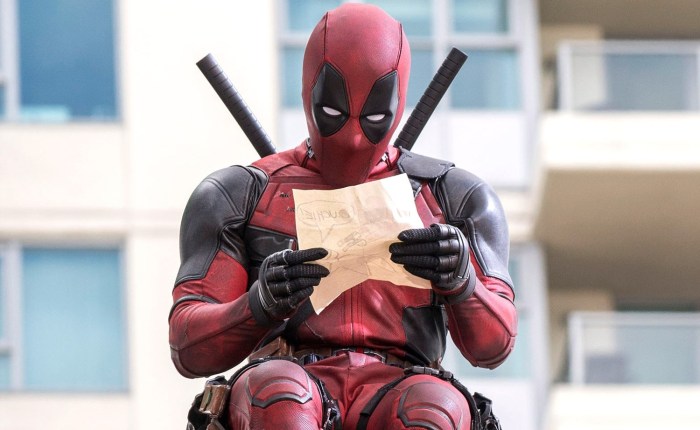
First Action Hero

First Action Hero

To say the movie market is over saturated with superhero films is an understatement. When they attempt to add depth, like Batman v Superman: Dawn of Justice, they face a backlash from critics and fans for not following the simple Marvel formula. If too many stick to the tried and tested, people become bored. Deadpool can’t be placed into either pigeon hole. So what is it?

The common line is it’s the R rated violent superhero comedy, that isn’t really a superhero film. All that is true. From the opening credits it’s clear the movie is very self-aware and the jokes are going to be aimed at everyone, including themselves. Having no fears about where the gags fly proves to be very liberating for the makers.

As in the comics, Deadpool breaks the fourth wall. The level as to which he does it here is surprising. When being dragged to the X-Men mansion he asks: “Stewart or McAvoy? I can never keep track of these alternate timelines.” Gags and nods come thick and fast, many leaving Easter eggs for those with knowledge of the character’s history. Others are just for pure laughs, like poking fun at Ryan Reynold’s turn as Green Lantern.

If that was his failed attempt at a superhero franchise, playing Deadpool has been his redemption. Admittedly, he’s had to take it to an adult level. This tone is set very early on. The plot moves along with the present day Deadpool flipping back to his past. There, he was in love with Morena Baccarin’s Vanessa, a prostitute he meets in his local bar.

These early exchanges between Reynold’s as Wade Wilson and Baccarin teeter on a level of cringe that would lead most movies to fail. Thankfully it lasts for ten minutes before their relationship is advanced and the more natural humour once again litters the scenes.

Having the origin story as a series of flashbacks prevents the script from stalling. It allows the laughs to flow while the heart of the characters slowly takes shape. Wade is diagnosed with cancer and then offered a cure from a man dressed as Agent Smith from The Matrix. What appears like a legitimate superhero programme turns out to be the world’s number one torture destination.

Their method is to inject a serum that stimulates latent mutant genes while exposing the subjects to high degrees of pain. The theory being stress will make the mutant strands activate to protect the host. It’s a case of death or super-powers, whichever comes first.

It’s no spoiler to say Wade Wilson survives, otherwise we’d have no film. He’s left with regeneration powers similar to Wolverine, with the ability to regrow body parts. The bad news is he is scarred to the point he doesn’t think Vanessa would take him back.

What follows is a revenge plot. He wants to find the man that caused the pain and visual damage. What stands in his way is the X-Men. Well, actually just two. Colossus and Negasonic Teenage Warhead. Their interference allows the British bad guy, named Ajax, a chance to realise who is after him and then capture Deadpool’s woman.

It’s all pretty simple but that plays to the film’s strengths. It’s not trying to be a philosophical superhero film and its adult themes means it doesn’t have to pander to the younger Marvel audience. The action sequences benefit from the removal of violent restrictions. And it becomes clear what type of film it really is.

It’s not a grown-up superhero flick. It’s a modern action film.

In the eighties, before the modern craze of super-powers and capes cluttered the box office, action men were kings. Like the westerns before, the niche market found a way to rule. Like the current superhero phase, over saturation became the norm.

Arnold Schwarzenegger, Sylvester Stallone, Jean-Claude Van Damme, Kurt Russell, Mel Gibson and Bruce Willis are just some of the big names from an era that stretched into the next decade of film making. After that, more actors took on roles in simple action movies, with varying degrees of success.

Once you realise that Deadpool isn’t a true superhero flick, the category it best falls into is action. The jokes are reminiscent of the cheesy humour people like Schwarzenegger would use. Except the humour here is noteworthy and the action sequences have caught up with the times. Long after superhero films have been shelved again, it’s easy to imagine Deadpool still fighting his way through enemies and cracking off edgy jokes.

The weakest part of the movie is how the X-Men have been shoehorned in. Obviously Wade Wilson is part of that universe, a failure to mention this would have been unthinkable. But Fox, the rights holder to these particular Marvel characters, would have been better advised to make this a standalone affair.

Their desperation to have something akin to the Marvel Cinematic Universe is a painful imitation. Deadpool should be allowed to find his place in the movie landscape, freed from the shackles he spends nearly two hours making jokes about.

Yes, he has mutant powers, but we can accept that and move on. Allow him to face foes in standardised action flicks. Leave superheroes, like the X-Men, to deal with their own impending apocalypse.


Greatest Achievement in League Football

Greatest Achievement in League Football

Leicester City winning the English Premier League completes a dream season for a club that battled to survival only twelve months previous. This unexpected success still belies belief, for months so-called experts have struggled to give reason for their insurmountable lead. A common denominator is that other teams have failed. This denies The Foxes the full credit they deserve.

The obvious comparison people have gone for is between the current Leicester side and Brian Clough’s Nottingham Forest. Clough’s side gained promotion from the old First Division and went on to win the title as the new boys. Throughout that season they had many doubters. It was deemed unlikely they could maintain the pace and stay at the top.

Sound familiar?

Of course, Forest went onto greater success but this initial title win has been the watermark for all underdogs in English football. Until now. Football was a different game back then. The gap between the haves and the have nots has never been greater than it currently stands. Massive clubs like Liverpool – who are the third highest spenders in Premier League history – have still yet to win their first Premier League title.

Clubs of Leicester’s stature are supposed to be happy with Premier League survival – nothing more. But they haven’t read the script this season, even after a bad start at Arsenal. It’s imperfect beginnings that laid the way for this journey.

Unlike Forest in 1978, who came up in good form and were full of confidence, they should have been riddled with doubts. A great escape didn’t mask their deficiencies. Sacking their manager, Nigel Pearson, after a series of explosive moments could have upset a fragile dressing room. Then they brought in The Tinker Man.

Claudio Ranieri, a man that had never won a top flight championship, was hired to ensure they reached 40 points. Many pundits claimed his arrival would send Leicester down, whenever anyone questioned this they were reminded his Greece side lost to San Marino.

As a polar opposite to Brian Clough, he remained a man happy to be in the shadows. Humble rather than full of Clough’s bravado. He was living the dream along with his fans. His humility sowed the squad together. He protected them from pressure, maintained expectation.

It was a case of all the pieces coming together at the right time. A manager with years of experience, a bunch of players with a point to prove, and the bigger boys struggling for one reason or another. That latter point shouldn’t be used against The Foxes. If teams failed to meet their personal targets for the season it doesn’t take away from Leicester’s success.

The league table never, ever, lies. Only three defeats speak volumes in a season where so many teams have struggled for form and stability. Some of the big guns may have been shy, but somebody had to take the chance. It was Leicester that came out head and shoulders above the rest.

A man that once tinkered stuck with familiar players. Unlike so many current managers, that claim to have an “ideology” or “project” as a cover for stubbornly sticking to rigid tactics, Ranieri evolved along with his players. They started the season almost playing like a Sunday league side, fast on the counter, looking like grinding out results was above them and it was only a matter of time before they became unstuck. Rather than become stale, they morphed into a side capable of chalking up one-nils.

It proves that cash doesn’t guarantee victory. The football goliaths should hang their heads in shame. Extensive scouting networks and the best facilities in the land have continued to show snobbery and fail to give talent within the lower leagues a chance. How many more Jamie Vardys are hidden, waiting for someone to take a gamble?

Naysayers have pointed to Leicester’s summer transfer spend but it is small fry compared to the likes of clubs expected to finish in the top four. With the new TV money coming into the game next season they now have the ability to spend. The sad fact is they will probably have to with the extra European games filling up their schedule.

Even if they do now splash the cash, it will be brought about because of success, not the pursuit of it.

The fear with Financial Fair Play was that football would be plunged into a status quo. That the dreams of fans up and down the land, clubs big and small, would be extinguished unless a rich benefactor spent billions. Leicester may have the new rich owner but it is good old-fashioned on the pitch ethics that have brought about the fairy-tale title.

The gap between the top and bottom has never been so high, the scope for daring to dream the impossible so low, but Leicester have changed this. Winning the Premier League is an achievement unlikely to ever be matched. Unless they go onto further success in Europe next season. But that can’t happen . . . can it?

It’d be a brave person that placed any restriction on hope following this triumph.

Should have Stayed Away

Should have Stayed Away

Certain associations will always spring to mind when discussing any country. For Germany the most popular hits will be efficiency, success with their national football team, sausages, and two World Wars. The latter ultimately brings up thoughts of the Nazis and Adolf Hitler. What doesn’t easily spring to mind is their aptitude for humour. That didn’t stop author Timur Vermes attempting to bring the two together in the 2012 novel Look Who’s Back.

It’s a brave concept, making one of the most diabolical men in history the protagonist of a satirical comedy. Vermes makes it more challenging for himself by setting the story in the modern day. So from the start he is left with difficult subject matter placed in a series of minefields, none more so than the genre itself.

All literature is subjective, comedy more divisive than most. Taking this into account some leeway can be afforded to Vermes. However, accepting it might not be a laugh a minute doesn’t disguise a failed attempt at humour or intelligent derision.

The idea of disarming the monster is nothing new in art or popular culture. In its cheapest form we all laughed at Saddam Hussein in Hot Shots! Part Deux. Vermes isn’t going for the slapstick, he wants a subtle disassembling of Hitler and his beliefs. Instead he creates a character ignorant to the reality of his situation or the true perception of those around him.

We go from Führer to Alan Partridge within seconds, and not in a good way.

Hitler starts the story waking in modern day 2014. His mind has no knowledge of world events following his death in 1945. Still dressed in full Nazi uniform he wanders the streets trying to make sense of his situation. He comes across a newspaper stand and befriends the owner. This chance meeting gives him and abode and serves as a catalyst for his acceptance of the year and time he finds himself.

Despite slowly becoming aware of the new world situation, he continues to reflect and assume that many of the current ways of life are because of Nazi influence. This is an easy way to highlight the ignorance of extreme views and paint Hitler as single-minded. But after an initial period of settling in, it becomes a distraction. Are we supposed to believe a man that must have had intelligence in order to initiate his evil intentions is suddenly so naïve?

As the story unfolds he is seen as a comedic method actor. His rants are seen as a clever way to belittle views that should never been aired seriously. This makes members of extreme movements assume he is a sympathiser and they send him warnings.

When anyone in the world of Vermes’ novel grows a brain and questions what he really stands for, they are removed. Like a national newspaper that ends up being sued by Hitler’s representatives and ends up singing his praises. Again, a nod to manipulation, but how those closest to Hitler fail to see his behaviour goes beyond the talent of an immersed method actor is questionable.

Some conversations take place that rely on the observer’s understanding that Hitler and those he is in dialogue with are coming from two different places. Some of these can be humorous, sadly they wear thin. A clever play on words only works so many times before the characters are reduced to mindless mush.

There is also an effort to show how Hitler won people over with a certain degree of charisma. Even that message fails when you consider in this version he goes from YouTube to TV star. Unless Vermes is trying to say the modern media is as evil as the Nazi war machine.

The actual translation of the German title is, He is Back. Thankfully for mankind, Hitler is dead and will remain so. Unless poorly implemented comedy is your thing, keep him that way and avoid this attempt at resurrection by ridicule.