Tomorrow Becomes Yesterday

Tomorrow Becomes Yesterday

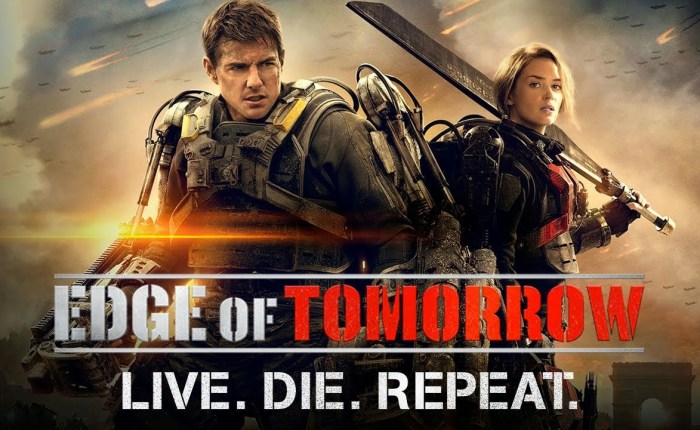
From the tagline: Live Die Repeat, and a sneak at the synopsis or a trailer, we know that Tom Cruise’s latest offering is a Groundhog Day with guns. We also see that, just like Oblivion before it, it is set in the world of science fiction. Tom Cruise is the last genuine Hollywood star, in the sense, he believes his name alone can bring box office success, rather than relying on a famous or established franchise. Yet, recent figures show is star, at least in North America, could be fading. Edge of Tomorrow attempts to repeat his former glories.

It is hard to distinguish Cruise’s modern set of films in traditional terms. The movie makers would argue that the global markets play a larger role than yesteryear. That not breaking even at home doesn’t matter when foreign totals smash the production budget. And it seems that outside of North America the Tom Cruise product is still very strong. What makes receipts over personal popularity incomparable across markets is the way different cultures absorb trends. Whether some parts of the world still adore Tom the same, or if they’re more likely to listen to positive reviews from critics, is hard to ascertain.

What we can determine is that Edge of Tomorrow promised an intriguing idea. Why it failed to garner more attention in America is a puzzle to me. Perhaps some were concerned after the lukewarm response to Oblivion (a film I quite liked). Once buckled into the film, after twenty minutes have passed, it’s clear the intriguing idea is being delivered into a top quality film.

It could have been so easy to fall into action film clichés, played it safe or worse still, played it lazy, but Edge of Tomorrow never does this. It feels authentic, like it’s aware and confident of the feel and direction it wishes to take. It harks back to action films from the 80s that set genre defining tones. Sure, it nods its head to things that have passed before; however, it only does this because sometimes those ingredients are required.

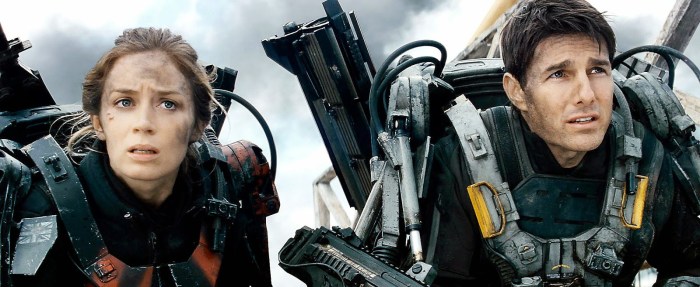
Also, make no mistake: it is packed with action scenes. Unlike most modern action flicks these aren’t there as filler. Like Aliens, a benchmark for all shoot-em-up films, the action belongs. It is never there for the sake of it until we get to the next scene with dialogue. Indeed, this story requires the repetition of action scenes, it’s what drives Cruise’s character, Major William Cage, along. The characters do develop, too. And unlike regular modern films in this genre, we are offered subtleties over spoon-fed emotions and progression. Discreet lines pass between Cruise and Emily Blunt’s female lead that never get the spelled-out, typical Hollywood, resolution. We just know it was there.
Blunt Cruise

Certain design aspects pay homage to what has gone before. The combat suit springs to mind. That particular piece of kit also could remind a person of video games, Halo isn’t a million miles away. It’s fitting that a video game gets a mention; they operate on characters “re-spawning” to rejoin the action, not unlike this movie. Also, the author admitted to using video games as an inspiration as he completed the story.

Don’t allow this comparison to fool you or degrade the vision of the movie, it’s not a simple run-through of a film. Okay, it’s not complex either; it just has that correct feel. It is solid storytelling combined with valid action, as opposed to over the top CGI and words that mean nothing.

While it is easy to criticise Tom Cruise for chasing a legacy as the leading superstar over deep, challenging roles (Born on the Fourth of July was way back in 1989, there were only a few roles with depth in the 90s, nothing since), if he seeks out this sort of popular film his talent isn’t totally wasted.

Could the ending be better? Perhaps? But one feels this film is all about the journey, not the destination. And thankfully for Tom, he’s waking up in a tomorrow where he still can command top billing whilst distancing himself from the slips of recent yesterdays.

Cruise Top Gun

Believing in the wizardry of cinema again, for the first time

Believing in the wizardry of cinema again, for the first time
 
I often worry that today’s generation are growing up in a time where the arts and mainstream entertainment underwhelms. They have the ability to access, via the internet, a vast selection of movies and music that make exclusivity or anticipation a relative unknown. It’s the disposable times where being impressed means “that’s cool” rather than mouth agape wonder.
 
Toddlers are the last example we have amongst us of innocent wonderment. My Godson – like many little boys – was into Thomas the Tank Engine big time. When he took his first train journey the look of astonishment on his face was a joy to witness. He kept repeating over-and-over: “choo-choo Thomas.” He couldn’t believe he was on a train. I don’t think any gift or anything he’s witnessed since then took his breath away quite like that. Nowadays the wonder of an iPad is no different to him than switching on a light was for me back in the 80s.
A movie action sequence filled with realistic looking CGI doesn’t impress him, it’s what is expected. A new song may be pleasing to his ears but there’s no anticipation for the music video release, and once he’s bored of it, YouTube will play him something else within seconds. When I was his age (oh my, I have become that old man figure) the build-up to Michael Jackson’s Thriller created a buzz that was richly deserved once the film was seen for the first time. Every Sunday the Top 40 on the radio mattered. And if a movie pulled a special effect out the bag that even resembled reality people were impressed. More than that, they appreciated the efforts and applauded. We allowed our imaginations to fill in the blanks that couldn’t be created and blur the tricks that never quite worked correctly.
For the large part we often became like a boy on a train for the first time
 
The very first time I crossed the line from wonder to a world beyond my imagination was when I watched The Wizard of Oz as a little boy. It didn’t just impress me with its visuals – which did make my mouth drop open in surprise when the sepia tones were replaced with colour ones – it absorbed me entirely. I may as well have been Toto because I stepped into that world with Dorothy. I was kept there by the characters, proving that story should always come first, without depth we fail to remain engaged. There were darker elements, too. Those appealed to me. Hints that sprinkled across the light of Ozwithout losing the flavour that kept me gripped in the first place.
 
The Wizard of Oz was released at the end of the 30s, so in many ways it’s understandable that over time audiences require new ways to be amazed. It worked so effectively on me because even though as a kid in the 80s colour TV was the norm, all my movie experiences had come from my grandma’s house. And she liked to put on many a black and white flick. I remember the first that caught my attention was King Kong. I really felt for that hairy beast. My imagination didn’t see a puppet swatting away planes but a real, breathing animal that was confused and out of place. Oz smashed colour into my movie times with grandma which added to that magical transportation.
 
In the modern era technology has given us many new fads and phases. CGI of course is now an industry standard. It is used in ways we don’t even acknowledge with our eyes anymore. Since its early use we have gone from noticing bad CGI sequences that asked too much of early models to knowing it must be CGI because the scope of say, a large action sequence like the one in 2012, can’t be real. However, the new movie goers of today take such CGI laced films as a given. Much like we do with audio, never giving a thought to the silent movie era. It’s expected, not appreciated.
 
Movie companies will always look for new ways to sell us a better product. They tried 3D movies in the 80s and failed. But they didn’t abandon the concept. They waited. They waited until the technology was more viable, the effect more breathtaking. Except, even in its hyped return, it never took my breath away. The difference this time is the movie companies are determined to make the 3D movie stick. They see dollar signs. I just wanted to see signs it was worthwhile.
 
One technology I had jumped on board with from the start was IMAX. After seeing the opening rooftop sequence of The Dark Knight I went from liking it to believing every movie needed it. So when theatres started IMAX 3D showings I decided it was 3D’s last chance. Avatar had failed to grab me. The story I found to be weak (and remember, story is the backbone any fancy effects need) and the visuals themselves had me mouth open but with a yawn rather than amazement.
 
I’m a reasonable chap so I threw another chance to the 3D IMAX world and went to watch Prometheus. I did get a better sense of visual depth but I’d seen that used in promising fashion in the Star Wars Episode I: The Phantom Menance 3D version; I expected more from Ridley Scott and the Alien world. At this point I was certain there would never be a movie that would make me a believer. I just hoped over time the fad would fade and something worthy would replace it.
But I was wrong. There is a need for 3D. But only when used in conjunction with IMAX.
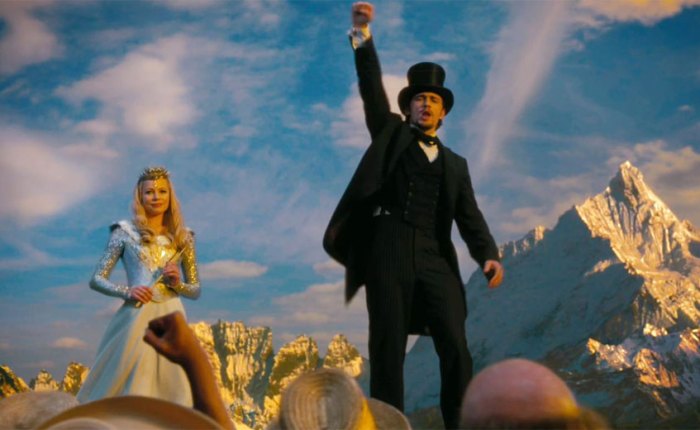
It’s poetic that the movie to make me see this was Oz The Great and Powerful. Any person that isn’t transformed into their childhood self during the sequence when Oz is in his weather balloon inside the tornado will never be impressed by anything on this earth again (or at least whilst sat in a cinema seat munching popcorn). The swishing sounds swallowed the senses that finally overloaded when his basket became repeatedly penetrated. The only way you’ll ever know what it’s like to be in a tornado is to find one and wait for it to take you.
 
The mouth stayed agape for a little while longer. When we see the Land of Oz for the first time it’s not just paying homage to the original film with the change from sepia to colour, it bursts into life making our normal everyday world appear blank and white. It’s like all the years before I’d seen a blurred colourless world that was suddenly replaced with HD and an infinite colour palette. And the depth. Such glorious depth. If I found the world’s best vantage point with a perfect pair of binoculars I wouldn’t see as far in comparison to the perceived texture of Oz.
 
Thanks to forums I have read criticisms of the film. Any that are not impressed with the effects I have assumed they watched a 2D version or a bad pirate copy. Or that they’re the sorts that are never impressed with anything. The doom merchants that try very hard to be overly gloomy. They’d be as quick to say an intelligent film is boring then say an easy going fun film is too simple. And make no mistake about it, Oz The Great and Powerful is supposed to be simple family fun. Some have been fast to praise the excellent (as always, it seems nowadays) Michelle Williams but claim the rest of the cast lack character development or engaging performances. I disagree.
 
In the title role James Franco delivers the performance in the best believable way. Grounding Oz with very earthly attributes. He isn’t supposed to be a knight in shining armour. He’s a flawed and selfish man from the start and had his transformation been too great it would have been the hardest piece of plausibility in the entire movie. Without giving away spoilers I’d say Mila Kunis had the hardest task throughout the course of the film, and whilst she never gave a Heath Ledger turn of redefining public perception of a character or making the movie hers, she certainly wasn’t lacking. Also it has to be remembered it was a film made for children. To expect more would be to drift away from the target audience.
 
It’s a shame that the plan Oz uses to take on the witches as the story draws to its end is symbolic of something we ourselves have become susceptible to. They’d lost belief in wonder like we have when it is used in our forms of escapism. Sami Raimi may well be the first director to fully extract the hidden potential of 3D when combined with IMAX and still deliver a complete movie. So it’s an even bigger shame we’re more likely to see James Cameron’s blue people again before Sam takes us back to Oz.