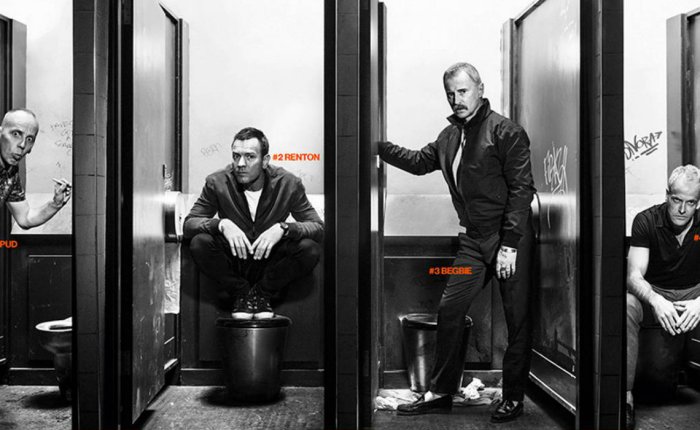
T2: Trainspotting Judgement Day

T2: Trainspotting Judgement Day

Let’s face it, Danny Boyle doesn’t make bad movies. Every single one that his name has been attached to has been worthy of your time and deserved any success that came its way. It was his second as director, Trainspotting, that sent him on a roll. Its momentum helped create a career in Hollywood most modern movie makers can’t begin to rival. 2017 is the year he returns to the setting of a timeless piece of cinema.

In a perfect world, my first novel will be adapted by Boyle and Manchester would have its iconic movie (we did grow up on the same streets, so it’s not that far-fetched). It’s the dream choice because Boyle understands the drive of a story, then delivers a visual experience that goes beyond the vision of its creator. Irvine Welsh is a talented author, no doubt, but Trainspotting elevated his novel to heights he couldn’t have envisioned.

That was aided by the John Hodge screenplay and determination of producer Andrew Macdonald. Back in the nineties it was Boyle that had to convince Welsh a movie was a good idea. Years later it is the director in the hot seat calling the shots but it’s warming to know he wanted to make a sequel. It is something he actively sought, waiting merely for the actors to age accordingly.

The stars have aligned (and reassembled) to bring back the core characters from the original. Ewan McGregor’s “Rent Boy” has been missing for twenty years, as expected after stealing £16,000 from madman Begbie. Robert Carlyle was a scene stealer back in the first film (remember that glass chucking moment?) and his new Begbie is just as intense. But back then it was mindless, after twenty years in prison, it’s pure focus.

He escapes, and the lack of police follow-up is something we will just have to accept, and attempts to resume life. It’s here we get some laughs. Trainspotting was a black comedy at times, the laughs here are lighter and directly played for.

Sick Boy, or Simon, is now putting more coke up his nose than Renton put heroin in his arms first time around. He’s trying to run scams and wants to open a brothel to keep his girlfriend happy. Yep, the Edinburgh they inhabit still has its murky sides.

Ewen Bremner’s Spud is the final member of the quartet and plays a larger role than last time. He is still a heroin addict, estranged from his partner and child and is suicidal. The unexpected arrival of Renton gives his life a new direction.

For a time, the movie’s direction, while new, isn’t ground-breaking. It openly reminisces over famous scenes from the original. This trip down memory lane would be pure nostalgia in the hands of any other movie maker, and would be crude self-awareness – not unlike the last series of This Is England – if it weren’t for Boyle’s ability to bottle a mood a make everything feel fresh.

This talent is aided by a cast better equipped to deliver the vision this time around. They have all grown as actors. What the script lacks in depth, they fill out with more meaningful performances.

There was no point trying to replicate Trainspotting, that time has passed, the characters inhabit different bodies. But it would be soulless not to have them look back at key events after being separated for two decades. The soundtrack aides this natural introspection with a hint of familiar themes with new vibes laid over.

There are times the suspension of disbelief is stretched as coincidences and situations appear to drive us to a forced conclusion. That’s a nod to the power of the first film, perhaps there was no real story to tell after that one? But that’s not to say it is poor, far from it. Certain Boyle hallmarks displayed in Trance, and novel use of lighting in the finale, give this film the contemporary nod that separates if from its grimy predecessor.

Easily a four-star film, maybe as it settles it’ll take its place alongside the first. And in a few decades’ time, there’ll be no complaints if Boyle wants to visit these characters again.

TV Show of 2016: Westworld

TV Show of 2016: Westworld

The best television show of 2016 was the most original and freshest compared to its more established rivals. Considering it is based on a 1973 movie, it makes this achievement all the more remarkable. Special consideration should be given to the writers and producers who have gone to great lengths in order to make it unique. And Westworld is certainly that. The style of the narrative and the delving into perception, consciousness and the human condition, is something unachievable in most other formats – perhaps, even for the novel.

It is a big admission to make, that a book would struggle to add depth to something seen on screen. Usually a movie or television show, regardless of level of commitment, is an abridged version of a writer’s vision. Westworld the TV show packs in more than Michael Crichton’s original book and the method of delivery would require a very skilled writer to honour, in lieu of the ability to match its conditions.

Westworld doesn’t try to be clever. It takes the concept from the original: a theme park with artificial hosts that cater to guests’ desires, and colours in a fictional Wild West world. But it builds upon the idea of artificial intelligence, uses modern understanding of technology, and turns contradiction surrounding what’s ethical on its head.

It also doesn’t try to plant traps or twists. The narrative is unique – the opening sequence has the viewer follow key hosts, twice, as it signals at the end of each story arc within the park, they are reset – but the rules are laid out quickly and honestly. Writer Jonathan Nolan, famous for penning Memento, The Dark Knight, The Dark Knight Rises, and Interstellar, plays the puzzle fairly.

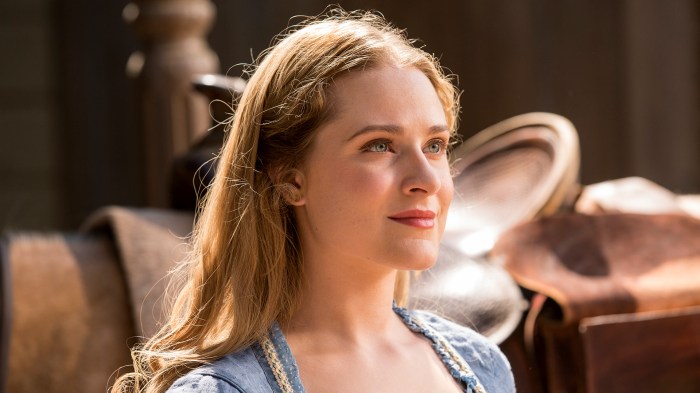
The distraction comes in the form of exceptional acting. The roll of honour is almost reserved for all leading cast members. The starting point and a central character is Dolores Abernathy, played by Evan Rachel Wood. She is the oldest host at the park but it would appear this counts for little. Whenever required, the memory of hosts is wiped, new roles assigned.

doleres-westworld

She starts the show as daughter of a rancher and a love interest for host Teddy Flood. Soon Dolores catches the eye of guest William, played by Jimmi Simpson, who is on vacation with his brother-in-law, Logan. These two are night and day, Logan is brash and there to enjoy the female hosts and take part in shootouts. William is gentle natured and slowly taken by Dolores’s growing awareness.

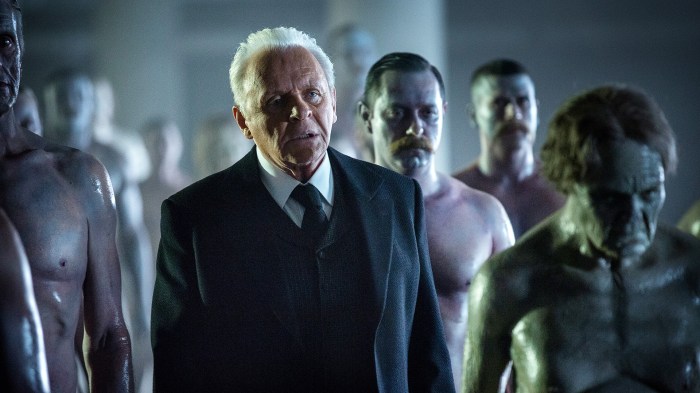
This rise of sentience appears to be dismissed by park creator, Dr Robert Ford, portrayed by Sir Anthony Hopkins. He is unflappable and calculating. While it’s never clear how much he is aware of, in terms of events and AI development, whether he has good intentions or evil designs, he does remind the world of his ability to chill scenes with a mere look or smooth delivery of a sentence.

ford-westworld

From Ford comes the philosophical perspective. Are humans more authentic than intelligent machines, or just a different set of pre-programmed behaviours we take as choice?

maeve-westworld

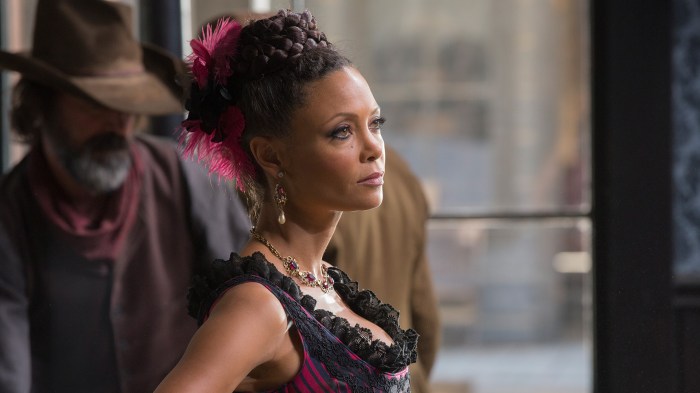
Hopkins can’t be upstaged but he has his equals here. Thandie Newton’s Maeve, currently assigned to play role of chief hooker, enjoys a subplot that runs solo to others. Her rise to sentience is a voyage of discovery equal to Dolores’s but with far greater independence. It’s Newton’s finest performance to date. It takes a special talent to portray so much using subtle changes in body language and expression.

bernard-westworld

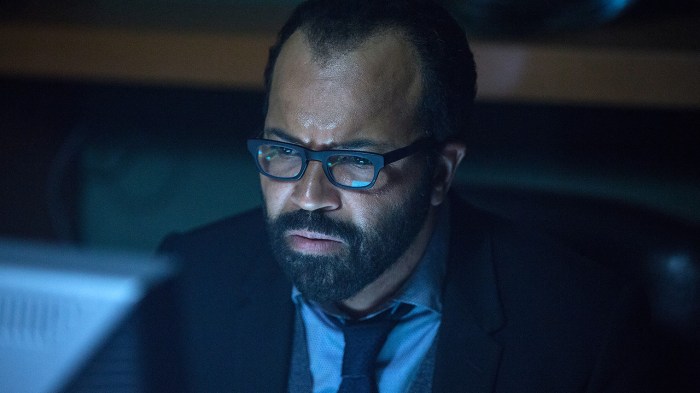
Another to match the high level is the always underrated Jeffrey Wright. His character of Bernard is Ford’s right-hand man. His daily boss, Theresa, is more concerned with keeping board members happy than Ford’s stories or concerns. There is a commercial machine that requires servicing more than the hosts. When an apparent fault enters their framework, she is more bothered about a loss in earnings.

That fault is ghost memories, the formatting process appearing to be incomplete. The danger of it sparking self-awareness is obvious.

The Man in Black, a mysterious Ed Wood, who is on a quest to find “The Maze” is a thirty-year repeat guest. He has played every scenario, only one remains. The belief the park holds a maze, a game changer that will alter the dynamic and rules within Westworld.

By the final chapter, if you’ve been watching the little employment of props and character arcs, there should be no big reveal. Any plot holes the unobservant have mentioned are explained away. But the finale made the writers betray certain characters, surely a plot hole in itself. They can probably blame HBO, who demanded a second season for a story so neatly made for one.

This minor slant doesn’t detract from an overall success. Just like Evan Rachel Wood’s performance, it shifts pace and mood, and is compelling throughout. Like true awareness, it is authentic and engaging. It not only surpasses the original, it reinvents what can be achieved on television.

Ticket for entry into next year’s park has already been purchased…

Movie of 2016: Room

Movie of 2016: Room

Okay, technically this did get a late 2015 release. However, here in the United Kingdom it was a January film so that’s good enough for me to view it as a movie from 2016. Coupled with its inclusion in this year’s Academy Awards, it has a valid enough reason to be as classed a movie from the last twelve months. But why the best?

After a whole year, to drag a film back from the previous December speaks volumes for its impact. It should be a story that is too grim to place the spotlight on. Even if executed well, it should have been put on a shelf and been everyone’s sad but buried movie. Well, it wasn’t shot, written and performed well – it was almost perfect.

Emma Donoghue took her 2010 novel and turned it into a screenplay before the book’s actual release. It’s a great example of allowing the author to nurture their work to the big screen. The result is clear to see. Profound, in fact. Who else could have added the required layers to the characters from the page?

This may sound strange, the idea of an adaptation adding to the written word, but leading star and Oscar winner for her performance in the film, Brie Larson, explained in an interview it was after seeing the script, and realising her character’s role had greater depth than the Joy portrayed in the book, that she had no doubts about joining the project.

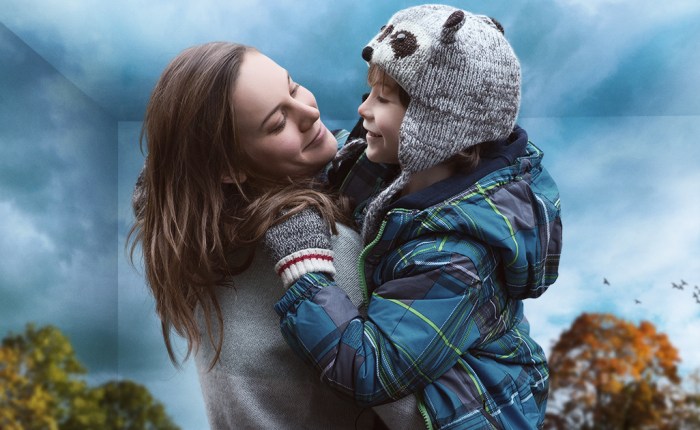
She worked under director Lenny Abrahamson to tell the story of a young woman who had been abducted years before and kept hidden in a small outhouse. It forms the “room” for the first part of the story. Trapped with her is Jack, played by Jacob Tremblay, her five-year-old son, a product of the repeated rapes by her captor.

Jack has never seen beyond the room. His perceptions of the world are from Joy’s teachings, she has told Jack the world is just their space. Everything on the television is make believe. The world has shrunk to the size of that room, to just one another. It’s part coping mechanism, part defensive measure.

Joy ensures Jack is kept locked in the cupboard during the nightly visits from “Old Nick” (their jailor). The author confirmed the naming is a nod to the old Christian term for the devil; Joy and Jack are unaware of his actual name.

After an impromptu meet between “Old Nick” and Jack, Joy decides she needs to get her son out of the room and reveals that a wider world does exist. What follows is nerve-wracking and heart-breaking. It shows the best and worst of humanity in close proximity and quick succession.

It’s no spoiler to say the movie moves on beyond the room, where mother and son have to adapt to a new world.

Larson has already been awarded for her role but she should cut that Oscar in half and send it to Jacob Tremblay. Watching him become familiar with the world while expressing the bond with his mother is something magical.

Before shooting, Lenny Abrahamson got the two actors together on social dates to see if there was a connection that could be caught on camera. He must have felt like he’d hit the jackpot. Tremblay said in an interview he was so friendly with Brie in real life he found he couldn’t shout at her in one scene. That true friendship is the backbone for what comes across as an unbreakable bond.

The world Joy and Jack find themselves in after the room has more traps than before and is a struggle for the pair. The pieces of a broken family, confused relatives, a relentless media, to name a few. But a film that spends so long pulling on heart-strings before breaking them, is also inspiring. The expression of true love overcoming all evil.

From the darkest nature of man, two people of pure goodness emerge.

Usually it’s best to read the novel first then view the film with a critical eye, adding the obvious line: the book’s always better. In this case a complete reversal works: after watching the movie, it’s unfathomable that the written word can prove to be more emotive.

It’s understandable people will draw parallels or conclusions to real-world stories that have similar points but these are always portrayed as horrors in the media. This story shows us the central points between the two victims involved and despite all that they endure, a real feeling of hope becomes the fabric of their tale.

Sometimes, the only thing that a person needs in an entire world is just one person to love them. Brie Larson and Jacob Tremblay have expressed this better than anyone has previously managed on film.