Qatar! What about Brazil?

Qatar! What about Brazil?

Ask football fans the biggest problem facing future FIFA World Cups and they’ll more often than not mention the heat issue in Qatar, more specifically, the calls from some quarters to make it a winter World Cup. What most of these fans, with their legitimate fears over Qatar’s ability to host and the nature of their acquisition, overlook, are the shortfalls facing next year’s tournament. It’s as if the world is turning the other cheek because of Brazil’s glamorous sporting history. But for the day-to-day folks on streets across Brazil they care less for football than they do for an improved quality of life.

The problem at the heart of the situation arose back in March 2003, when FIFA announced that South America would hold the tournament. It sounded reasonable, the continent had been travelling to World Cups across the globe since it last acted as hosts during Argentina ’78. Without a challenged bidding process from the other confederations it was left to the countries within South America to create candidates. Much muted alliances never materialised; hence, Brazil was chosen without a rival bid. Less choice is bad. That lack of competition was unhealthy. We’ll get back to that process – of bidding and attempting to sell your bid – in a minute. The cause has resulted in a Brazil unprepared and a tournament, which by all accounts, should be in jeopardy.

The cancellation of Soccerex, a football industry conference scheduled to take place in Rio de Janeiro, should have raised alarm bells. Instead it was reported with a murmur before being buried amongst far more entertaining football stories or snippets from Alex Ferguson’s autobiography (or character recollections). The organisers claimed the ongoing civil unrest was to blame. The State of Rio says it was due to Soccerex lacking private funding and they wouldn’t spend any public money to hold the event.

The truth may well be both, just played off against one another for political gains. There have been well documented violent protests across Brazil; Soccerex probably would have liked to have been helped out with a donation from the Brazilians. For the State of Rio to claim they wouldn’t waste public money in this manner is quite cheeky, though. As if to appease the protesters that claim public services should be funded over the World Cup, the Brazilian figure heads are ignoring – or failing to mention – that their World Cup has already cost them three and a half times that of the South African one, and more than double Germany 2006.

Where has all that money gone? Stadiums alone amount to £550M, another £2 billion on airports, £1.1 billion for works attached to the “Growth Acceleration Programme”; this doesn’t include spending on things like the buses, they come in at £375M for a better fleet. Facts and figures can be generated all day, to put it in the best perspective a recent protester was quoted saying: “We love the World Cup, we love sports – what we don’t accept is a government which wants to look good by investing millions in the World Cup but forgets about health and public education.” Sounds reasonable to me.

The truth in that statement highlights the hypocrisy and self-serving attitude that football’s governing body lives by. They care little for the effects on the supporters of the beautiful game as long as their bank accounts increase exponentially. Brazil didn’t even have to bid against other nations and prove they could host an effective games, let alone afford one. And FIFA doesn’t care if a country runs itself into the ground as long as they make money in the process. A football club may be banned from competition if it exceeds Financial Fair Play guidelines but it’s perfectly acceptable for a nation’s health service and education system to crumble if FIFA make a tidy sum of cash.

These are the people of the world they claim to care so much about. The people they wish to bring football to. The people that are all equal and should come together under the banner of football. But, for the people that come together, some are more equal than others. They fail to take strong action against clubs when their fans use racist chants. They suggest openly through President Sepp Blatter that homosexuals should refrain from activity during the Qatar World Cup. So certain groups are willingly ostracised if it serves their greater good (which in FIFA’s case is always money).

This brings us neatly back to the topic of bidding for a World Cup, and selling your bid as an attractive option. Well Qatar went about it in a slightly different fashion. To cut a long-ish story short, they bought the World Cup. Why waste time having the best bid when you can just purchase the thing instead. Allegations have since been retracted but it’s plain to see how the process really works. If it was just about new areas hosting and the strongest bid winning then Australia would be 2022 hosts. As it stands they are poised to strike FIFA with a legal serving. If the 2022 does indeed become a winter games they will seek compensation for expenditure incurred for their failed bid. They entered a process for a fixed tournament with stringent parameters, to then shift it to a different time of year voids that process. Sounds reasonable.

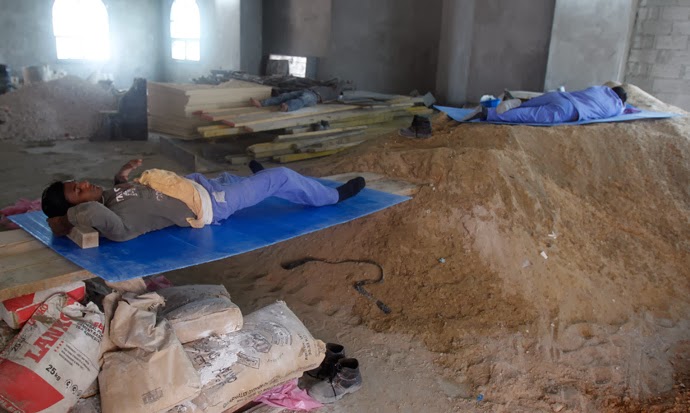
The time of year appears to be the big debate with Qatar. The English say it will affect three years of Premier League fixtures if it’s moved to winter. Michel Platini, very maturely, pointed out football’s fixture list had suited the English for one hundred and fifty years so we could change just once (albeit three years running). These squabbles take away from the most important point: we should spare a thought for the migrant workers building the 2022 World Cup. Often denied food and water it’s estimated that up to four thousand will perish. It’s not slavery if it serves FIFA; it must be acceptable. Because the World Cup is all about bringing people together.
Qatar

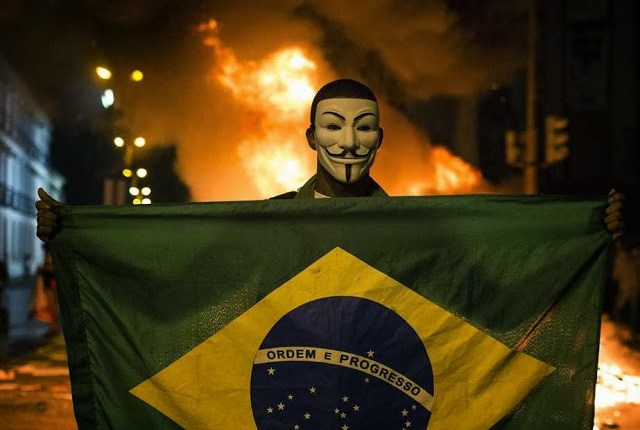
And the next World Cup, that’s getting ever closer, is bringing the people together. The real people on the streets. Mass protests hampered the Confederations Cup, this served as a warning that was ignored. Since then the outrage has become more violent with police vehicles torched. Yet, people power alone might not be what brings Brazil 2014 to its knees, ironically it could be the same greed and bureaucracy that drives its Big Daddy, FIFA, on.

Most major tournaments face that scare mongering close to the curtain call. Whether it be an Olympic games in Greece or a World Cup in Russia (they’ve come out of this article unscathed and unmentioned), they’ll always be panic that the place won’t be ready. But they always are and always will be. The chances are, civil unrest included, Brazilians will take to the World Cup, embrace it and put on a great show. There’s also a high chance they won’t be ready in time. No really, this isn’t me scare mongering now. For several months I have been back and forth to Brazil. What I have found is a county unable to function in a modern and professional manner. It ties itself up in red tape at every corner and there’s always a tax be applied at an extortionate rate. They lack the impetus to move forward because too many are looking for short term pots of gold. All those billions spent – from public money – will have lined the pockets of the rich while structures remain half built with no sign of progress.

For the fans that do come to Brazil they’ll be met with aged modes of transport, crowded roads alongside semi-built ones, legitimate ATM machines that still magically clone cards, and locals that will enjoy the games then return to under-funded lives and a country with less cash than ever to spare for its working class. Perhaps a last minute switch to the USA won’t be such a bad thing, as long as we keep Diana Ross away from the opening ceremony.

Qatar and Brazil, two very different World Cups. One bought, then a further £138 billion ploughed in to build it; the other taken as the only choice and built with money that should be supporting future generations. Both will continue to face criticisms along the way, before collectively we all will watch as fans, taking the immoral choice to ignore human rights issues for short-lived sporting entertainment, embracing ignorance, thusly legitimising wrong doings. Two World Cup bidding processes without genuine competition, and what are we left with . . . .perhaps no competition at all.
Manchester International Festival

Manchester International Festival
The Manchester International Festival, or MIF, has already started to fade in our memories just like the sun is slowly starting to be obscured by clouds. Before it’s no more than a light drizzle in the mind’s eye I shall recall my highlights.

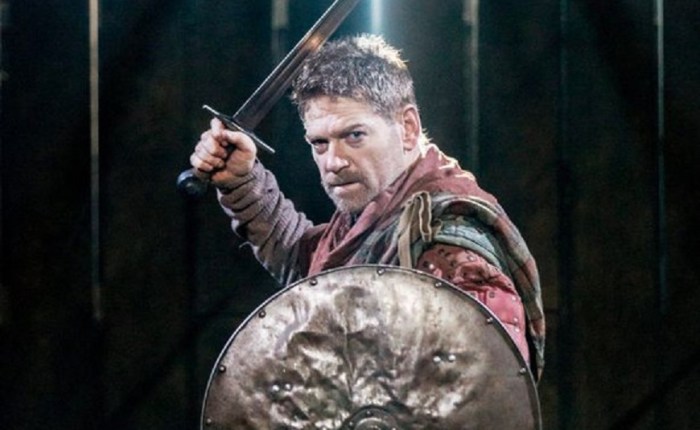
I felt as privileged witnessing the great actor undertaking a Shakespearean role as I did being party to the unique setting. The deconsecrated church in Ancoats provided an absorbing atmosphere that allowed the play to feel large when required but was intimate enough to engage during the delicate nuances each top performer provided. Two tall wooden viewing platforms faced one another with a mud filled aisle separating them. An aisle that was to become the stage throughout, along with the former alter area that gave way to candles beneath the stain-glassed windows.

From the Wicked sisters starting us off with a haunting interpretation that had me squeezing my partner’s hand, to the initial battle scene played out with rain and mud, the experience never let up. Branagh was particularly engaging earlier on as he wrestled with his guilt. As he became the ruthless leader his Lady Macbeth, played by Alex Kingston, demonstrated the plunge to madness with chilling effect. There wasn’t a weak performance during a play that delivers some of Shakespeare’s best lines.

Much has been made of how close the action was in relation to the public – to the extent we were warned not to wear clothes that needed dry cleaning – and how it made the opening sequence all the more breathtaking. Whilst all that talk has been valid a special mention should go to the sequence when Macbeth is shown the prophecy that concludes with the procession of Kings. The alter area had a line of flames that cast a hellish look over a contorting image below. If I say it was multiple actors squirming beneath a patterned sheet I wouldn’t be lying but it would be a great discredit. Periodically a face would appear as it pressed upward through a now seemingly thin cover. What the prophecy foretells is scary enough for Macbeth; the literal vision was a pure art of horror.

Will I see such a strong cast again in an iconic play? Maybe. Will it be in such a great venue? Probably not.

If a viewing of the Scottish play has people discussing the obsession of power then Massive Attack v Adam Curtis took a string of that theme and expanded upon it. After waiting for the curtains to open I found myself in a horseshoe of big screens, meaning the documentary is played all around the public, with the band behind the apex section. Adam Curtis’s film starts with the East and West in the 1960s. He quickly, and without debate, tells us how the two opposing sides want to control and change the world. Through a series of national events and interweaving personal stories we move onwards through history. As we go we’re told the governments realised they couldn’t control the world so they stopped making us worry about that “other side” and to panic over ourselves instead. When computer technology came along they tried to construct models to predict the future. Of course, they failed.

Curtis gets you on his train of thought early on and takes you along his predetermined viewpoints without room for consideration. There are no alternative interpretations, only what he sees as fact. And it works. At least for the purposes here. The soundtrack – because that’s what it was, it was no gig – was played out as a perfect accompaniment. When Nirvana’s version of “Where did you sleep last night?” started to play I couldn’t help but join in. In doing so I reinforced Curtis’s view of the two-dimensional world we now live.

Curtis himself has been quoted as saying the documentary is about the illusion of power and power of illusion. In a world that runs this way it’s us – the normal, everyday majority – that appear to suffer. It seems that Curtis is from The Matrix opening our eyes with a red pill but feeding our minds a blue one of his own creation.

Festival square saw its fair share of the majority each day. It provided a relaxed meeting place with food and drink. The Pavilion also gave us Rob da Bank for a Friday night mix of music and a slideshow of Mancunian music history on the cinema-esque screen. It could have easily slipped into the Land of Cheese but the DJ chose his soundtrack with excellence.

The following night I witnessed New Century Hall and Despacio. Tickets were in high demand for what promised to have all the ingredients of a good boogie. James Murphy of LCD Soundsystem fame joined David and Stephen Dewaele (Soulwax, 2Manydjs). Had you previously seen the latter at a festival you may have been underwhelmed but they played a way befitting the venue. Seven large speaker sets that appeared to have been robbed from a retro-future bar lit up whilst a disco ball glittered across the high walls. It was more disco than dance. Those in search of a Sankeys (RIP) replacement should have been mindful this was still MIF, and as such, a different audience.

A personal highlight of the festival was Tino Sehgal’s This Variation. Beforehand all I knew was it was sensory overload due to a darker setting. I’ll be honest, I was expecting a light show that perhaps distorted images on a projector in a dark room, or something like that. It’s fair to say I was going in blind. Quite apt then that what I found it to be was a room in pitch-blackness thus making me completely blind. If you recall, the Weird Sisters in Macbeth managed to put the heebie-jeebies up me, so being a dark room, bumping into strangers, hearing shuffles and whispers and chanting had me wishing I was in a diaper. After what seemed like an hour (it was thirty seconds) those chants became a full-on dance song. I quickly turned for the exit.

Not proud of feeling like a chicken and getting a strange look from the volunteer outside when I remarked: “That was pretty scary,” I took a few minutes to have a word with myself. I reasoned that a blind-person in a dance club had more noise, more strangers around them, more cause for confusion. I reached the conclusion I should try again. This decision was accelerated by the fact I was also watching the mise-en-scène by Mårten Spångberg entitled Epic. My mind is open to varied interpretations but I couldn’t escape the idea later that evening people wouldn’t have understood it but would be spouting pretentious statements about its true meaning. When it got to the point a guy in a see-through top was waving his out stretched arm slowly to a David Bowie song whilst doing a belly dance that started in his shoulders I knew it was darkness or bust. Although it’s only fair I come clean and admit I stole this particular dance move and used it at the aforementioned Despacio night.

Second time in the pitch black setting of Tino Sehgal I found my inner force. Okay, not exact bravery but the intimidation was more comfortable than the idea of facing more Epic. Slowly my eyes, thanks to a dim purple light above, started to make out shapes. The slap of white paint across the walls gave the room a dimension. A little while longer (about fifteen minutes) I could make out the performers. They were moving around, moving up to guests that had acquired night vision. Together they produced all the required beats, hums, special effects and vocals. They danced at times like a dance troop, at others formed segregated areas. In the dim light it struck me I was in an alternative reality’s idea of a nightclub. It had music, people, an underground feel like a twisted Turnmills (RIP). Moody acid.

Familiar songs sometimes appeared with a unique twist as the talented performers made their way through each variation like one organism. For a person that started out so scared I amazingly didn’t want to leave. So I didn’t until they formed a single wall and sang “it was time for us to go now” with cheeky smiles. It hadn’t all been music, Sehgal likes debate, too. There were periods when the show stopped and the performers would raise and discuss various points. Like the income you earn is of great consequence but the job you do could be of little consequence. Even these staged chats had an ad-libbed feel that complemented the experience. It wasn’t just the music that faced time-outs, very briefly the purple light above shone full beam giving the blackness a rest. By now the light was the unwelcome stranger to the rapture given by the dark.

An experience so good I went back the next day and went through it all again, this time even receiving a hug from a performer as we danced in close proximity. Much closer to the action than even those on the front row at Macbeth.

This year’s MIF was a resounding success. It succeeded in opening up the city and its people in every possible way.