An agreement has been made between UEFA and liberty media to ensure the commercial and sporting integrity of the Champions League and Formula 1 survive during the coronavirus outbreak. Plans have been drawn up for a closed-doors Super Tournament in Abu Dhabi. The state will host a truncated Champions League tournament from a single venue, with multiple matches staged each day.
The Abu Dhabi F1 circuit will be used for sprint races on the days between football matches. The track has several configurations and the belief is the spectacle of numerous shorter races – something seen in junior formulae – will go some way to make up for the loss of the high-flying global tour.
UEFA will invoke Clause 14.7 from its combined agreement with member associations to void domestic leagues to ensure their crown jewel competition can be completed. It’s understood there are reservations to the move in Madrid and Germany over fears Sheikh Mansour, a member of the Abu Dhabi royal family, could use the tournament for political favour following Manchester City’s trouble with Financial Fair Play.
Both Liberty Media and UEFA will increase their respective prize funds – with the assistance of the Abu Dhabi royal family – to convince teams and nations the benefits outweigh any downsides.
Once the deal is officially ratified, it’s expected the first two weeks in August will be revealed as dates for the tournament. Football will then go into a shortened pre-season phase, Formula 1 may pause the season again in the hope it can be revived later in the year.
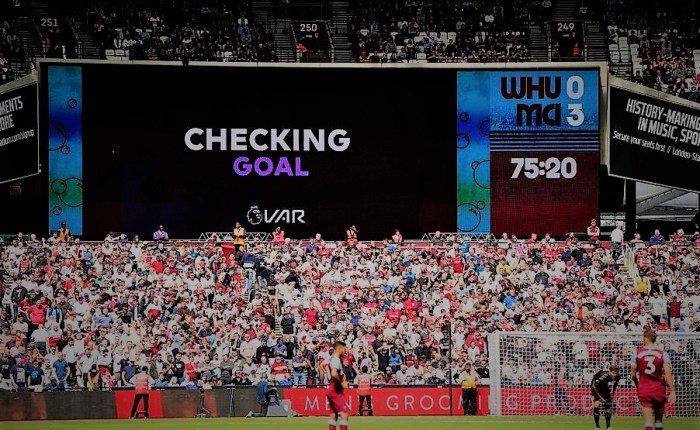
It was supposed to remove controversy. Establish clear rights from wrongs that the human eye can’t ascertain in real time. The theory of using technology to assist referees was a sound idea, it’s the inception that has been questionable. Even as the authorities iron out teething issues and officials acclimatise to the new era, Saturday’s game between West Ham and Manchester City revealed some fatal flaws.
VAR has been responsible for some controversial decisions
before this weekend. We’ve seen a World Cup final swayed by a handball that the
ref initially declared wasn’t deliberate. Upon being asked to review the
incident it’s only natural the alarm bells begin to ring in his head. It’s not
like there was a boxing-style judging panel at work behind the scenes. It’s
reasonable to assume the ref felt VAR officials disagreed with the call and
were giving him a second chance.
Watching back any handball in slow motion will change the
colour of the argument and lead the referee to rule against the player. Unless
the incident occurs at the Etihad in a Champions League tie. Fernando Llorente’s
arm made contact with the ball and gave Spurs a vital goal that saw them progress
to the next round.
The problem on that night was the referee didn’t have the
full range of angles to make a measured decision. Viewers at home saw the ball
hit the striker’s arm while the man making the important call was set up to fail.
A rule with the pitch-side monitors should be that unless all available feeds
can be presented to the ref, no VAR can be used.
The Llorente incident also highlights how a change of angle can
make the same incident appear entirely different. No football ground comes with
console game style replays, where any moment in time can be paused and viewed
from any position imaginable. The rule makers will have you believe VAR is an
objective device but depending what evidence is produced, it becomes a
subjective experience.
On Saturday lunchtime, Manchester City once again saw VAR do
its best OJ Simpson impression and failed to wear the gloves.
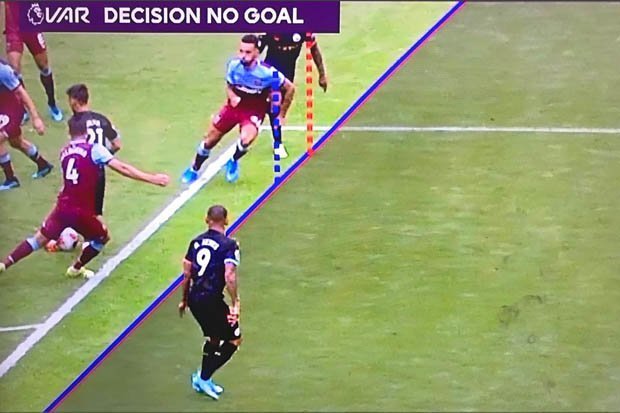
This time, the snug fit was even tighter than the infamous bloody hand garments. The VAR replay showed that Raheem Sterling had been deemed to have drifted offside by a couple of millimetres by virtue of his creeping shoulder. Despite how close it was, the law now emphasises that offside is offside, regardless of how small the gap. Something that Steve McManaman was quick to accept and drive home on BT Sport’s live commentary.
This law requires the acceptance that offside is treated like a ball going out of play, as David Walker from Read But Never Red explained in a Twitter post: “the ball going out of play…it is objective and will never be judged on being ‘a clear an obvious error.’” It’s worth noting David Walker sees the law as pedantic and agrees with the objections to its interpretation.
That sounds very reasonable and using the example of a ball out of play is a clever trick. But a ball is a known shape and size, the touchline is in a fixed position. Determining the exact point on different players where the shoulder begins via a screenshot, leads to an unknown.
The technology can cope with fixed lines and known objects,
such as balls. That’s why tennis and snooker have seamlessly incorporated Hawk-Eye
technologies for years. Football is more complicated. It’s fine for Goal Line
Technology and has been a success because it can apply the same principles.
Calling an offside has too many moving parts. It becomes a subjective decision.
Firstly, a VAR official has to decide when the ball is
played. At what nanosecond in time does that foot move the ball forward. Unlike
snooker, where it can be deemed when the cue nudges a solid ball, we’re talking
about a foot – seen from a camera in the gantry – that presses into a ball which
changes shape slightly upon impact. At the same moment in time, the official needs
to determine the movement and exact position of the last defender and attacking
player.
Here’s the next – and for the Raheem Sterling incident –
most subjective call of them all. The reference point of the player is the
first part of his body he can legally score with, in this case it is deemed to
be the shoulder. Some online have opened the debate that a defender can score
an own goal with his arm, but to avoid adding another pedantic in an issue
filled with them, we’ll stick to shoulders for now.
From that same far away, grainy camera shot, an official now
needs to draw a downward line starting at the player’s shoulder. The best
motion capture artists in Hollywood can’t determine exact body shapes with such
restrictions. Even if the players were naked, it would be difficult to draw precisely
from the shoulder. With a baggy football shirt, it’s impossible.
The millimetres that called Sterling offside could easily have been redrawn – without anyone raising an eyebrow – from a slightly different point on the alleged shoulder and declared him onside. The reference angle of anything is exaggerated the further away from the source. Think of a triangle. What starts as a millimetre travels to metres apart at opposing corners.
VAR isn’t going to disappear now but it can’t stay the same when
it’s ruining games with long delays, killing celebrations, and making decisions
based on subjective application of reference points. Until better technology
exists, goals like Sterling’s should stand if both the attacking and defending lines
are so merged. The margin of error is larger than the distances involved
between the two lines.
VAR should be seen as a work in progress that was poorly
implemented in the first instance and still looks shaky. Until everyone is more
familiar with its restrictions, it should be pegged back and relied on less.
Otherwise the most exciting league in the world will become the home of
disbelief and frustration.
It a shame that the first Football Reflective post in little over a year, and the one to start a new season, is one that’s bound to aim negativity at the defending, record breaking, title retaining Premier League champions. If the sole purpose was to kick-off the 2019/20 campaign with a moan there were far easier targets, but we can save VAR for another day. And FFP is only ever two minutes away from another (well deserved) public stoning.
Manchester City caught the attention of the searchlight by
skipping across the prison yard, hoping to escape with thousands of Ticket Points.
Until Wednesday afternoon, all seasoncard holders were expecting to collect
additional points for every away game they attended. The season long
uncertainty for many: weighing up on which day of sale the window will open for
them; will it even get that far down the list; should they buy for a dead
rubber European away game to collect valuable bonus points, is now a thing of
the past.
The new system strips away the secondary method of obtaining
points. From now on, only matches played at home generate Ticket Points. This
is an attempt to kill the secondary market of ticket resales. Or if we’re to
call it for what it has become, touting. Those sat atop the Ticket Point pile
can never be caught. They have first dibs on tickets so they always buy them,
many regardless of their intention to attend or not.
It has to be said, this isn’t the case with all those rolling
around in excess Ticket Points but it’s enough to ensure the points rich stay
wealthy and the rest are left scrambling to get away games under their belt. Many
will sell on at face value but there are those that profit financially. The
problem with City’s new set of rules, is they effectively freeze the points
system. Everyone desiring away games presumably has a seasoncard. Whatever the
points gap is now, will never change.
Unless a person opts out of cup schemes or avoids the Platinum
reward scheme. This has been much maligned over the years. The offer of paying
£50 to double Ticket Points earned. A little brown envelope to the ticket
office so they can make you appear more loyal. Unfortunately, what was once a
subtle bribe will now become a necessity to prevent the 1% widening the gap during
a period of stasis.
On top of the away game Ticket Points deletion, the upcoming
season will see randomly selected supporters chosen to collect their ticket in
person from the opposition’s ticket office. They will be given notice five days
before. It’ll be interesting how many are selected per game, and how many then
claim they’re actually unable to attend. In principle, this is a sound idea. It
prevents the secondary market, it’s the execution City need to master. It was a
disaster for European away games.
It’s also an option that should have been tried alongside the traditional method of issuing Ticket Points for away games. A strict vetting procedure could have stopped the 1% buying tickets for matches they couldn’t attend and allowed those below them to slowly amass some genuine points.
Instead, City have gone for the nuclear option. Hopefully
this isn’t Phase 1 of a wider operation which sees the average fan further
marginalised and given less hope of securing match day tickets.
On a plus note, they have acknowledged the difficulties
facing younger supporters. If old fans in the Ticket Points middle ground can’t
play catch-up, spare a thought for the 18 to 25-year-olds. They never stood a
chance. The new season will see 5% of
away day ticket allocation going into a ballot. That comes out at 150 of 3,000
seats. This seems a fair reduction to general sale to get those denied by
nothing more than their year of a birth, a chance to see the Citizens away from
home.
Again, it’s a shame they won’t be awarded points for it. The
status quo will remain. Unless the club have a wild card up their sleeve. Will they
be monitoring fans that regularly attend away matches who would previously been
denied due to their low points and inflate their Ticket Points accordingly come
the end of May?
The new proposals are bound to receive a backlash. They deal
out more punishments than rewards and fail to address underlying issues. It
also opens the door for more tiresome “jokes” about empty seats. Hopefully, before
next season City will conduct a proper consultation with a wider audience of
the fanbase and not a select few who speak without elected authority.

 The Reflective Page