The start of a Halloween weekend sees many turn to their movie collection to dig out the best fright-fests. This invariably leads to discussion that asks the big question: What is the scariest film ever?
The answer from these quarters: The Exorcist.
As firm as that answer will always be, so is the chance it’ll find disagreement. Since its release in 1973, the horror genre has gone through many reinventions in order to maintain appeal. The search for shocks, of the jumpy kind or those that push the boundaries of what is acceptable to show on film, means the psychological chills have seen less usage.
Sure, The Exorcist wasn’t averse to special effects designed purely for a gasp, and to test the viewer’s constitution, but it’s credit to its real scares along the way that these still stand-up. Admittedly some have lost their immediate power after years of being parodied, either on purpose by the likes of French and Saunders, or by cheap copy-cat horror productions looking to recreate some of the magic.
Those untouched by the movie are the ones most likely to dispute the existence of life after death. But if you spend your days praying to a force for universal good – or just believe there might be something after death – then playing with the notion of a bad side becomes unsettling.
The build to the evil emerging is a deliberate slow step. In the opening scenes we witness Father Merrin unearth a token in Iraq, signalling a demon has returned. This backstory is developed in other media, here we just get a hint and he later alludes to it himself.
A skip to Georgetown and we are introduced to the life of famous actress Chris MacNeil (played by Ellen Burstyn) and her daughter Regan. What is most remarkable about Linda Blair’s performance of the twelve-year-old is that any evidence of over-acting can only be found in the pre-possession scenes. Before the demon is inside her, the acting is cringe worthy. But once she is asked to perform as a possessed human, it’s far too believable.
The seemingly innocuous occurrences ramp-up until Regan herself displays changes in behaviour. Being famous comes with suspicion. It’s conceivable a daughter exposed to the Hollywood lifestyle would have a sense of theatrics. When Chris seeks help from local priest Father Doctor Damien Karras (double titled to highlight he is also a psychiatrist), he even asks if Regan could have accessed recreational drugs.
The Father is assured that hasn’t occurred. What let the demon in was Regan playing with a Ouija board. But the case comes at a time he has lost his faith in God. This morphs once he begins to believe Regan could be possessed for real and it’s not a disorder, fake or a result of being exposed to drugs or a situation.
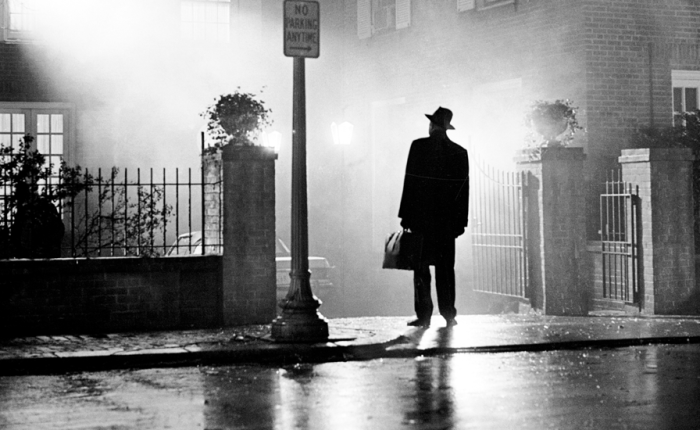
He calls in Father Merrin for assistance. The shot of Max von Sydow’s Merrin arriving on a dense, murky, atmosphere filled night is beyond iconic. If a sense of a character and his importance to a film has ever been better captured then that footage must be missing: This is the pinnacle of achieving such a feat.
Merrin brings great advice (“But he [the demon] will also mix lies with the truth to attack us.”) and prior experience. And soon begins a battle between good and evil, to a suspense filled climax.
It may sound an over-the-top reaction now, but upon its release stories of nuns sprinkling Holy Water as people stood in the queue to watch the film, added to its notoriety. It’s the sort of marketing campaign movie execs wouldn’t dare dream up. Such was its impact, those that saw it, understood why. In England, St John’s Ambulance had extra staff on standby as people passed out when confronted with the images.
Its 1998 re-release in the UK is when this writer appreciated those concerns from the seventies. Undiminished by time, it was equally as shocking and thought provoking.
By the time the famous head-spinning scene arrives, you are absorbed and truly believe the young girl is possessed, the words that follow, “Do you know what she did? Your cunting daughter?” are chilling. Far from the potential comical, dated look it should have had two decades after being made.
Remarkably, when adjusted for inflation it is the highest grossing film Warner Bros. has ever released. It explains why they were quick to call for a sequel but makes one wonder why the successful formula was abandoned. More surprising is how no movie maker has ever gotten close to replicating the style.
Usually when a movie gets rated number one in a genre, it is revisited on a fairly regular basis. The Exorcist is the exception to this rule. Even though it’s a horror movie and this is Halloween season (and the eagle-eyed viewer will note the story takes place over Halloween) it’s not one I’ll be revisiting any time soon.
After seeing it in the cinema during its 1998 run, three weeks of nightmares followed. A little older now, after a viewing this can be reduced to three uneasy nights.
Until such a time the demon can be faced once again, the aim is to try and enjoy “Tubular Bells” as nothing more than a piece of music, not associate it as the perfect soundtrack to the perfect horror movie.
 The Reflective Page