United for Manchester

United for Manchester

Divide and conquer is one of the oldest tricks in the book. If Wednesday’s terror attacker had that goal in mind, he failed miserably. An already close-knit city has formed an even tighter sense of community. Things that are usual cause for division have been shelved. Manchester stands together.

They say by not carrying on with life, the terrorists win. That’s why after the 1996 Manchester bombing, a Euro ’96 game was played the next day, and the Manchester Arena continued to host events the following week.

This time can be no different. The Courteeners will play Old Trafford Cricket Ground on Saturday, and the team from the football stadium still face a Europa League final tonight.

To give an example of this togetherness, a week ago, this Manchester City fan was trawling the Internet for an Ajax shirt. It was going to be worn as I cheered on the Dutch side. The idea of ever supporting Manchester United – up until the events following Ariana Grande’s concert – seemed alien, unlikely: downright impossible.

Now, for tonight at least, it would be preposterous not to get behind a team flying the flag for Manchester. Many of the players – especially younger members like Rashford, Lingard, and even Pogba who lived in the area from the age of 14 – will feel a personal connection. The same goes for members of staff making the journey.

It also goes for the 9,500 United fans in the Friends Arena, and the thousands more travelling to Stockholm to show support.

They will all become the embodiment of a mourning but determined spirit.

For weeks, the press has made The Red Devils favourite to claim the only major piece of silverware that has yet to grace their trophy cabinet. The tragedy aside, it was always going to be a harder game to call than those assumptions.

Ajax are a younger side that play free-flowing football – when given the chance. It sets up an interesting match where the pragmatic Mourinho style will be expected to absorb the early flurries and eventually see off the promising Dutch side.

AC Milan probably had a similar idea heading into the 1995 Champions League final until Patrick Kluivert had his say. United need to make sure nobody becomes the new Kluivert tonight. It would have been easier had Zlatan Ibrahimović been able to signoff his Man United duties on home turf.

Instead they will look to other – rested – faces for success. There are enough mature heads, with plenty of experience, in the Manchester United contingency to ensure the sense of occasion, and the gravitas of events back home, do not overwhelm. You can imagine someone like Rooney using it as motivation to propel the players forward rather than sink with the burden.

After the terror attack, the United players observed a minute’s silence in training. Tonight, they will be greeted with ninety minutes of raucous support from the red and blue sides of Manchester. Sure, at the start of next season, if they’re sitting in Pot 2 of the Champions League draw, it’ll be mildly annoying.

But for now, they have nothing apart from unequivocal support as they represent a great city, unity, honest people, the innocents affected, and the freedom of our way of life.

This City Stands United.
Ranieri Reign Makes Case for Manager Rules Review

Ranieri Reign Makes Case for Manager Rules Review

Claudio Ranieri – the man responsible for taking Leicester City to dreamland – was brought crashing back to reality with the ruthless nature of the Premier League once again being displayed by a twitchy chairman. He becomes the fifth top flight manager to leave his post this campaign, and the fourth out of the last five to win the title only to be axed the following season. The time to analyse each individual case on its merits has passed – if Ranieri can be sacked, there is no measure of safety to consider – it’s time to question the staff system as a whole.

Before offering an alternative to the current way of life for football managers, it’s worth noting every club making a change has clear (if cold) reasons for doing so. Swansea believed Bob Bradley was in a sink or swim scenario with his lack of Premier League experience and showed no signs of doing even a doggy paddle.

Mike Phelan on the other hand, had shown signs of improvement at Hull City. His seemed a thankless task: a small squad, no money, an eleventh-hour appointment. Despite the cards being stacked against him, he soldiered on. That aforementioned improvement didn’t translate into the only element club owners care about when faced with relegation: points.

That’s why Crystal Palace replaced Alan Pardew with Sam Allardyce. The former went on long runs without collecting many, the latter almost guarantees survival.

It’s the fear of not surviving that prompted Vichai Srivaddhanaprabha to wield the axe at Leicester. (Yes, the chairman’s name was copy and pasted.)

It’s the players at the King Power who should be taking ownership of a change in their application and work ethic. It’s clear to see their interest levels have only peaked in the Champions League. They used player power, regardless of what Craig Shakespeare says in press conferences, to avoid taking direct responsibility for their attitude and performance.

Ironically, the man favourite to replace Claudio Ranieri – Roberto Mancini – left Manchester City for the same reason.

He lost that dressing room and Manchester City hired a pussy cat. The Foxes have gone the opposite way, fired Mr Nice Guy and hired a disciplinarian. Makes sense when people need whipping into shape but the players who lacked professionalism will rue the day they got a good man fired.

All these managers needed the same thing: Time.

The panic of losing Premier League status, and all its rich financial rewards, has chairman all too eager to press the panic button. The League Managers Association (LMA) have a thankless task. They have no negotiating power in the boardroom and can only transition managers into the job market. The chance of them ever taking a big club to tribunal is on the same scale as it was for Leicester to retain the title and win the Champions League this season.

If the managers and the LMA can’t enable a fairer work place, who can?

Well, it has to come from the top. It would require UEFA to make it law or for the Premier League to take a bold step and make rules for clubs on these shores that would remove the equal playing field they currently enjoy with the rest of Europe.

And while this sounds outlandish at first, it’s worth remembering the Premier League has set out to differentiate itself from its European equivalents. The new branding seen this year, without the need for a sponsor, was an effort to make the Premier League a global symbol like the NFL or NBA.

It’s from those American counterparts they could take inspiration.

Before we get to their methods, there is already a system in place that could afford managers protection: the players’ transfer window. Seen as an awkward disruption nowadays (ask a West Ham fan about Dimitri Payet) and a way for clubs to inflate prices, it does offer one thing to players – a settled block period without the threat of being moved on.

Of course, a club can fire a player by releasing him from his contract, but they see the financial loss as too great to ever do this. Unless the player involved is Joey Barton. This gives players a fighting chance to prove themselves. And when the writing is on the wall, at least they have time to prepare and fashion a deal with their agent for a new club.

The modern day manager goes week-to-week – sometimes day-to-day – with the threat of the chop in the background. If they were afforded the same protection by only being removable during the player transfer window, clubs would have to show the same commitment they gave on day one of the manager’s reign.

Maybe it would only result in the January transfer window becoming a crazy merry-go-round of players and managers, but there’s also a chance clubs would buckle in for the season. Clubs that still felt the need to part ways when relegation loomed would only be able to promote from within, giving backroom staff a chance and some form of continuity.

But maybe the Americans have got it correct. In NFL, coaches are fired on the first day of the regular season. It’s known as Black Monday and several sackings is seen as harsh. A regular debate within NFL is whether firing bosses actually improves results. They still make changes during the regular season but across American sports it’s not as prevalent as it is in football.

So, what if there was no transfer window for managers in football because clubs couldn’t replace a Head Coach with an external appointment at any point in the season?

It would ensure clubs got behind their managers 100%. They’d have to make it work. The time, and undue pressure a lack of it brings, would be afforded to coaches often struggling against resistant waters. Some players don’t like a new ethos or coaching methods and in today’s football world, they know all the power lies with them.

If a chairman had to retain his manager, that power would swing back to where it should be: with the boss.

These ideas are the extreme end of the spectrum but the results they offer would please fans and clubs alike. Currently agents have more influence than the people that work long hours coaching teams and preparing for matches. A safety net and legal assurances for managerial staff would reduce this ugly side-effect of today’s game.

It seems far-flung right now, but everything has a breaking point. If the Premier League carries on its current trajectory, it will buckle under its own weight. The manager sack race is just another indication football is in silly season.

It’s time for calmer heads to prevail, and loyalty and respect to have more bearing than the potential of a few short-term victories to snatch the pound signs flying around.

The Real Fan Problem at Manchester City

The Real Fan Problem at Manchester City

After watching City overcome Monaco in one of the most exciting European nights imaginable, it’d be easy to think the next article will be wax lyrical about Pep Guardiola’s side. Or, perhaps to fit in with the mainstream media, it will take away from the spirit shown and focus on the many faux pas we saw and bemoan two poor defences. It will do none of these things but it will attack a certain element of Manchester City, while defending its most important aspect: The fans.

When Willy Caballero saved from Falcao’s penalty, this writer celebrated like City had won the Champions League, such was the level of tension and passion in the stadium. It was a night where the Etihad took it up a notch. The fans feeding off the team’s fight, the buzz energising the players. The perfect example of the symbiotic relationship that should exist between those in the blue shirts and those in the stands.

If the people that have the direct say in City’s success – the men on the pitch – can see the importance of the fan base, why can’t the people that organise the club’s affairs do the same?

The official line from Manchester City will be that the fans are the number one priority: #Together. It’s great marketing, and on some level, there’ll be people that work for the club who believe it. But constant oversight and a lack of corrective action makes one doubt how genuine the words are at corporate level.

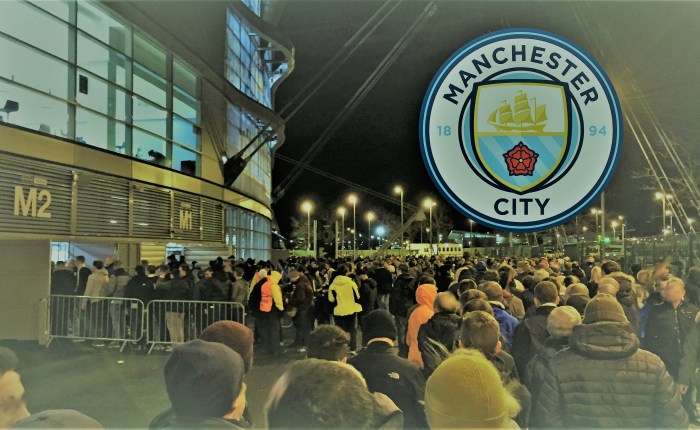
Of course, the example last night, and reason for this article, is the continued problem of gaining entry to Etihad Stadium on match day – especially European nights.

To have it happen once is forgivable, twice is disconcerting but no major issue, for it to happen constantly with no cure in sight is sacrilege.

Just like the Celtic game at home, queues zigzagged around the concourse, patiently waiting in lines that needn’t be there but the club refuse to address. Thousands of fans – that have paid full price for their ticket – are expected to miss up to twenty minutes of the first half. All because of City’s arrogance.

Before we go any further, let’s nip the two favourite retorts in the bud once and for all.

Get to the ground with plenty of time to spare.

Fans shouldn’t have to arrive one hour prior to kick-off to ensure access to their seat.

Increased security measures will cause delays.

The extra searches do not slow down or hinder access to turnstiles. They mean the person(s) being searched are delayed by thirty seconds. The queue moves past them, the turnstile never stops turning.

Another, weakly spoken, response, is fans arriving at the wrong gate cause delays. This does happen, and cup games mean new guests or people in different seats, but it does not equate to thirty minute delays. If there is any argument for ticket issues, it’s staff not directing supporters quick enough when their card or ticket is repeatedly jammed into a turnstile that’s displaying a red light. Patience, in this moment, actually saves time.

No, none of the diatribe aimed back at the fans adds up. A main contributory factor is clear: unnecessary redesigns have purposely limited the volume of traffic at preferred gates.

Take the M2 to M1 situation. Once upon a time – before the club started their final corporate solution of hospitality clubs and glass tunnels – allowed fans in the third tier of the South Stand to use both turnstiles. And the traffic flowed, not a queue in sight.

Fast forward to the present day, a wall has been built meaning those gaining entry via M2 can’t walk across to the stairwell for the upper tier. The preferred upper class customer no longer need worry about the upper tier riff raff sharing their turnstile. They can watch them queue instead.

If there’s one thing we’ve learned from Donald Trump’s comments, it’s that people don’t like walls being built.

The annoying thing about this wall is that it has a lovely set of double doors. The same doors that are opened post-match to speed-up everyone’s exit from the stadium. But, for reasons known only to City – those doors must remain closed until the ref blows his whistle for the last time.

etihad-stadium-the-problem-doorIt’d make no sense to allow the queue to dissipate and direct people once inside. Best to keep lots of people disgruntled, right? And it means staff manning the M2 side get to stand around and avoid work based stress. Excellent for all involved…

etihad-m2-empty-gate

Maybe United fans not being in the Champions League have gotten the last laugh: it gives them a free night to take jobs at the Etihad and help run City’s European nights.

It’s not as if City don’t know how many people to expect or can’t call upon vast experience of running match days. No fan should have to wait thirty minutes to gain entry to a ground. And it keeps happening. Against Everton, as reported here, the staff at the turnstile broke procedure and opened the exit gates to allow fans in. That, obviously, can never be the solution, but by now there should have been one.

Instead City show signs of madness, repeating mistakes, expecting a different outcome, and continue to neglect the working class fan. You can put your mortgage on the fact that if ten corporate visitors were made to queue outside in the cold for twenty minutes into the first half, there’d never be anything that resembles a line of people within a mile radius of Eastlands ever again.

Traditional fans, worried about becoming marginalised, continue to see basic consideration diminish. There’s no suggestion here it comes right from the top – Sheikh Mansour has gone to great pains to maintain inclusion for all City fans, all over the world – it’s the daily heads of office that are guilty of mismanagement, oversight, and a lack of care.

The current entry system (not security checks, the poor use of all turnstile resources) is not fit for purpose. If the people responsible for direction and management of City match days do not use some common sense to remove the current façade, they make themselves as effective as the crippled system they stand by.

Before the decision makers in Abu Dhabi consider further expansion, player acquisitions or ground improvements, they should look at the basic running of Etihad Stadium. There’s a lot of deadwood that needs removing.