Interfering with Play

Interfering with Play

The offside rule used to be a tool used for misogynist jokes about a woman’s inability to understand a law that “real” men saw as child’s play. Nowadays, it is the rule itself that has become a bad joke.

The constant tweaking of the rule (Law 11 in association football’s, Laws of the Game) started with a desire to make football more exciting. As far back as 1925, it has been altered for this very purpose. In that year they modified the last defenders from three to two, this led to 1,673 more league goals being scored that the previous season.

There is clearly a precedent for the rule to slow the game down, with constant free kicks and breaks in play, or goals being ruled out. The modern variants of the law have centred around if players in offside positions are active. Or interfering with play. The problem is, the open to interpretation approach is what’s now interfering with play.

The rule is written as such:

It is not an offence in itself to be in an offside position.

 A player is in an offside position if:

  • he is nearer to his opponents’ goal line than both the ball and the second-last opponent

A player is not in an offside position if:

  • he is in his own half of the field of play or
  • he is level with the second-last opponent or
  • he is level with the last two opponents

Offence

A player in an offside position is only penalised if, at the moment the ball touches or is played by one of his team, he is, in the opinion of the referee, involved in active play by:

  • interfering with play or
  • interfering with an opponent or
  • gaining an advantage by being in that position

No offence

There is no offside offence if a player receives the ball directly from:

  • a goal kick
  • a throw-in
  • a corner kick

Most people that watch a game of football understand the basic principles of the offside law. The flaw with it lies in the opening line: It is not an offence in itself to be in an offside position.

This ambiguous statement evolved from former amendments that stated: obstructing the opponent’s line of movements or making a gesture or movement which, in the opinion of the referee, deceives or distracts an opponent, before changing to: challenging an opponent for the ball.

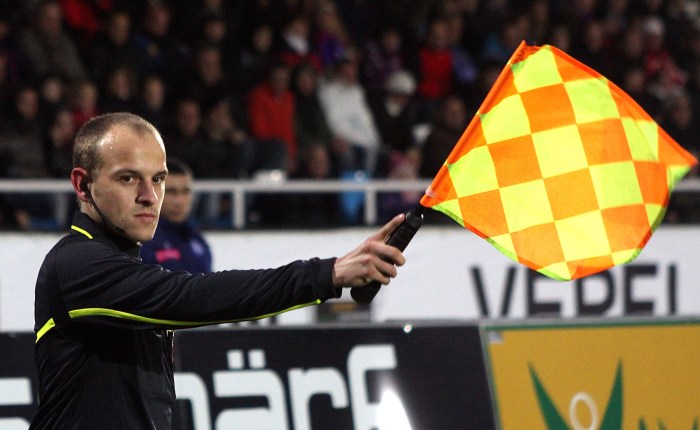
Now we have first and second phases of play, being stood in front of goalkeepers on free kicks but officials making on-the-spot assumptions about where the ‘keeper should be looking, as if they are robots that ignore their peripheral vision.

As Brian Clough famously said: “If you’re not interfering with play, what are you doing on the pitch?”

We all want to see flowing football, but not to the detriment of the laws that govern the game. FIFA will never implement a rule change allowing dangerous tackles to be ignored if a goal comes from the subsequent attack.

So why are we being asked to ignore dubious application of an age old law to assist illegal goals?

The attitude to ignore the rule is becoming quite pandemic. Everton scored their first goal against Manchester City in the opening leg of the League Cup semi-final with Romelu Lukaku stood in front of the goalkeeper. The hazy understanding of the rule means it stands with little debate.

Juan Mata scored a beautiful free kick against Shrewsbury Town in their FA Cup clash. Unfortunately, a three-man wall, placed in front of the goalkeeper, never made it back onside before the ball was struck. However, the officials believed they weren’t interfering with play. If you’re not interfering with play when stood in front of the goalkeeper, you never will be.

This attitude to ignore now stretches to even simple decisions. Wayne Rooney scored against Derby County in the previous round, after being marginally offside before receiving the ball. BBC commentator Danny Murphy declared he’d rather enjoy such a good strike than focus on whether or not Rooney was offside. So the message is clear: It doesn’t matter about the rules if it looks good.

This ambiguity needs to end. It’s making the referee and linesmen’s jobs almost impossible. Sooner, rather than later, a major tournament will be decided by a dubious call that sits in the offside grey area.

Nobody wants to see the Champions League or World Cup decided with a goal that leads to an inconclusive debate about if a player was interfering with play.

It’s time to go back to basics. If a player is stood in an offside position when the ball is played, then he’s offside. Leaving it open to interpretation places an unnecessary spotlight on a sport already riddled with mistrust and bad calls.


Financial Fair Palter

Financial Fair Palter

A little over two years ago I made my opposition to Financial Fair Play clear in Financial Fair Prejudice. At the time the arguments against the system felt like the final futile attempts of resistance before football’s fair days of competiveness would be glazed over by a constant status quo. But this week Michel Platini proved that money’s more fluid than the previous positive counter-arguments. He announced that FFP would be eased this summer.

Victory at last? Not quite, well, not quite yet. It won’t be until the end of June we see exactly how much UEFA will ease the current rules. It also remains open to debate how they will do this and maintain a governable system. It is a step in the right direction. Or more accurately, a shuffle away from the wrong one.

Throughout various articles here I have attempted to demonstrate the reasons FFP is wholly unfair. That’s not to say I scoffed at Platini’s other remarks this week, namely the claim FFP was “working well.” To some degree, it is. If you recall, I have always been an advocate of a system that prevented a future Leeds or Portsmouth situation. My distaste for FFP has never meant I’ve overlooked this sentiment.

The figures themselves highlight the areas where FFP has been a positive force for change. But these should be used with caution, as other figures indicate an alternative version why FFP is being eased. Far be it from me to think ill of Platini or UEFA, or question their motives, but one could argue they aren’t acting out of benevolence at this point.

First, those good stats. The easiest demonstration is the net debt across all of Europe’s clubs. This has fallen from €1.7Bn to €400M over the three years from 2011 to 2014. Here in the Premier League transfer spending was the same in the recent January window as it was twelve months before, but notably less (by approximately £95M) than the 2011 January window. If we examine the club punished on our shores due to FFP, Manchester City, they have reduced their wage bill by £40M over this period.

Some will argue clubs, such as Manchester City, have shuffled some wages on their accounts (it’s reported support staff at Manchester City now are on the City Football Group’s payroll) but no one can deny a concerted effort has been made by England’s leading clubs to become more financially responsible. This is if we ignore the example set by Manchester United since their departure from the Champions League.

Newly crowned champions, Chelsea, did their business in the summer and reluctantly had to balance the books to bring in the signings they wanted. Arsenal have been doing this for years and continued to do so. The aforementioned City may not have spent as wisely but it was all within the tight confines their punishment afforded. Relegated Burnley resisted the urge to splash to survive and depart the top flight as a healthy model.

As a whole it appears that the majority are making the transition from potentially reckless to greener pastures.

This article now sets a record for the longest I’ve spoken about FFP without a criticism. Don’t worry, I have a few to hand. One last positive before we get there, and an example why we do need FFP to some (lesser) degree, the QPR model. They claim to be cutting costs but they are leaking money without any sign of on-field progression. Shareholders wrote off £60M worth of debt but they are still accountable to the Football League for financial irregularities. This alone could see them plummet through another division. Tony Fernandes isn’t fooling anyone when he says the club has learned from previous mistakes.

Fernandes is also the embodiment of the fair-weather rich chairman, fans of clubs without money threaten to those with new wealth. Manchester City fans have heard for the last few years, “What happens when they get bored and take their money with them?” It’s similar to what people levelled at Chelsea supporters when Roman Abramovich first appeared on the scene. He’s still going strong and so will Sheikh Monsour for years to come. It’s the QPR owner that has invested in a reckless, ill-advised, foolish manner, without an overarching plan or ways to improve club revenue streams, and he’s also the only one that has flirted with the idea of turning his back on football.

Roman and the Sheikh are successful business men. Most of these are rich because they are good with cash. They don’t consistently lose money. Rich football owners – those running the club with cash, not debt – are bound to apply similar rules. Losing cash isn’t in their DNA. The difference with Fernandes and his sporting ventures, QPR and the Caterham F1 team, have been treated like pet projects. Chelsea and Manchester City were extensions of successful business portfolios. As such they were examined and reshaped to flourish as a business. Success on the pitch was intertwined with eventual profits off it.

What irks me is the two-faced side emanating from Stamford Bridge in recent years. They should take applause for being an example of why FFP is bad for the game. The Chelsea model should be a term for how to achieve success. Instead they shade over their accelerated growth period and pretend they are on board with FFP for the good of the game. They’re on board to prevent new money clubs catching up with those in the elite party.

José Mourinho speaks as if he’s a crusader for FFP. That heavy spending – regardless of how it is sourced – should be stamped out. That this is Year One and the income you generate now is the only allowed money. No accelerated growth periods for anyone else. This is repulsive for more than one reason. Mourinho never mentions how Chelsea posted a £140M loss in 2005 in order to transform the club from also-rans into the outfit they are today.

During this heavy investment the model has seen Chelsea become the third largest generators of income in the Premier League. They only achieved this by spending in the first place. José also speaks as if they now comply because of the rules. This is a fallacy. In 2006, then Chelsea Chief Executive Peter Kenyon, claimed they would be self-sufficient within a year. His figures may have been out but the business model was clear: Roman didn’t want to run at a loss forever. Just like Sheikh Monsour, he knows to make a better business an initial loss has to be absorbed.

As usual Arsène Wenger sits in room complaining without many listening. This week’s snippet from Moan Corner was how UEFA lost FFP when it removed youth investment from the calculations. It seems Mr Wenger not only wanted to ensure the Have Nots never will have, but that the Always Haves also corner the youth market.

This encapsulates the reasons why the voices that at first appeared ignored, (I myself wrote: “There’s no point arguing against Financial Fair Play anymore,”) have suddenly found welcoming ears. The idea that clubs could never catch the big guns without being allowed to follow a well-implemented growth period, albeit running at a temporary loss, found traction. It did this slowly and with a dawning realisation across Europe.

The impending court cases levelled against UEFA have played their part. They highlight the moral hypocrisy of the current system but more worryingly for defence lawyers, the legal problems set off alarm bells. UEFA is tied to EU laws. And while the EU doesn’t want to see a sport in their lands defy current convention, they are accountable by their own mandates. Freedom of trade and competition laws being the major headaches.

Also, the money in football generates its own mini-economy. If the cash at the top is prevented from purchasing assets then smaller clubs find reduced revenue. Debts may reduce for those chasing the perfect model but ends can’t be met in smaller boardrooms. Blackburn Rovers are a solid example here. Their debt has increased by £24M in spite of reducing the wage bill. The secondary economy – but most important to me – is the impact on the fans. FFP, in its original form, will mean supporters pay the price as clubs try to balance the books.

Everything has a breaking strain. For the current FFP it came from European clubs struggling to stay on the top level without extra investment. They saw the Premier League sell its TV rights for £5.5Bn and realised the gap was about to become unbridgeable. Even Platini admits the Italians have asked for FFP to be eased even though it is other nations that currently benefit most from foreign investment. Monaco had already reacted by loaning out Falcao to remove his high wage from their books. Their loss was the gain of nineteen other clubs in the Premier League.

It’s possible big clubs like Manchester United – going through an accelerated growth period of their own – and Real Madrid lent on UEFA to lessen FFP because of the impending cases. They do operate with large debts; something that clubs like City and PSG have argued should be factored into calculations. Easing FFP takes the spot light away from those with big debt but large fan bases, reducing the microscopic moral investigation.

The most telling statement from Michel Platini was: “Any potential changes will look to encourage more growth, more competition and market stimulation while strengthening the emphasis on controlling spending and safeguarding financial stability.”

MCFCAc

He’s summoned up perfectly the Manchester City model, the very ethos I championed before FFP was introduced. But don’t worry Michel, hindsight is 20/20.
Constructive Citycism

Constructive Citycism

Manchester City have become a football club that appear easy to dismiss out of hand when they are playing well, quick to tear apart if their form dips, whilst questioning every non-footballing action through a harsh microscope. Within the club’s own fanbase the line between offering constructive criticism and being a supporter has blurred. Let’s take a look at the factors that don’t add up.

First off I’ll deal with the least favourable portion of the chat: City’s own fans. Lately there has been a generic response from certain supporters to question anyone that dares highlight an area where the team could be performing better. The usual Action Man pull-string line sounds something like, “Remember that we used to be shit.”

MCFCRelegated

This is something that can’t be argued. But I doubt that these fans were walking away from Maine Road hiding their disgruntlement in those darker days. I dealt with the pain during the infamous season in the third tier of English football by having an extra pint at half time. Over said drink I’d criticise the players as I saw fit. It didn’t mean I wasn’t 100% behind the team, but to fail to see areas, and then comment, where the club should be better is playing the role of a blinkered fan.

I’d never boo a City player, I don’t think I even groaned like some with Lee Bradbury, nor would I offer an in-depth dissection of the team in the wrong public forum. But between fellow City fans there’s nothing wrong with pointing out where it’s going awry or which player needs to offer more. I’m not saying we should forget those bad days – they make me all the more grateful for the present – but to lean on them and ignore shortcomings shows a lack of ambition. We’ve moved on as a club and with that the mindset has to evolve.

This brings us to the next area of concern: The way we are perceived by others. Nowadays if a City fan shows any degree of confidence he is labelled as arrogant. That he has somehow forgotten that City was once a non-threat. And yet at the same time the opposing voice will point out that City should be winning because of the investment spent on the squad. It makes intelligent debate impossible when so many are unfairly gunning for the blues.

Much is obviously made about the money spent. My views on Financial Fair Play have been written here many times so I’ll spare retreading old ground concerning this oxymoron. Needless to say the detractors appear happy to see City fined and squad restricted in Europe this season, without ever explaining why the double standards within FFP are acceptable to them.

When City was playing catch-up, thus spending heavily, the process was demonised in the press. The very same press that wrote in terms of endearment and excitement when Manchester United splashed the cash this summer. Even now they report with growing arousal that they will continue the splurge. But they’re allowed because it’s their money, despite being in debt and City don’t owe anyone a penny. Other teams are applauded for business choices that bring about investment from foreign markets but City are viewed with suspicion for adopting new methods like sister clubs.

MCFCAS

The double standards do not stop there. Much is written about how excessive spending is killing the youth system in England. Yet the ambitious academy City has recently launched wasn’t met with the same fanfare as one at United or Anfield would have been. Sheikh Mansour’s best intentions are conveniently under-reported, areas open to interpretation overplayed. If any doubt exists to United’s youth development we are reminded about the class of ’92, as if it’s the only measuring stick, still recent and relevant.

If this now appears like negative comments to detract from facts it’s barely worthy when placed alongside the professional examples. Many articles written nowadays are undoubtedly click-bait for the masses. The tabloids will be targeting groups they believe have larger numbers, like Liverpool and Manchester United fans. This is fine if the articles are club centric and not written to the detriment of others. Instead the click-bait stories are often written in a manner directly attacking competitors with tripe. The chosen teams are protected and given weekly prayers the press hope are prophecies; the unfavourable clubs are knocked down and written off without consulting the available evidence.

For the last two Premier League seasons the UK press has awarded the title early. Liverpool secured it with a month to spare last season, this year the Chelsea Invincibles took the title in November. Liverpool was lauded last year, as if the third highest spenders in Premier League history had never spent a penny, that Brendan Rodgers was a demigod and they “deserved” it. Pellegrini went about business like a class act, without ever receiving credit for hard work and the correct choices that brought about City’s most successful season.

LFCDreaming

This season we now sit on twenty games played, City and Chelsea have the exact same record, nothing separates them other than alphabetical order. But it’s still Chelsea that play the role of the chosen ones. Stats aside, because there’s no real split there, it’s hard to understand why the press and media are so quick to dismiss City. While they are busy romanticising over Mourinho’s team they aren’t asking the appropriate questions.

Had the two teams been tied at New Year but it was Chelsea that had suffered the loss of all available strikers throughout December, with their best one still out for a few more weeks, and John Terry had been out the side, then the anticipation that they would go on to secure the title once they were back to fitness would make sense. However, it’s City that have battled on with depleted numbers but for some reason this hasn’t been placed into any equations. Nor has the probability that at some point Chelsea are likely to lose major players. We know how City respond with men down – they close an eight point gap. How will Chelsea fare when they lose big names for long periods?

Chelsea are still spoken about as some unstoppable force, a City side carrying significant injuries is sneakily brushed aside. I’m not saying the press shouldn’t report City’s weaknesses, but they should be placed into context. Any areas that could be better only serve to show just how strong the best parts of City’s play are. Everyone is a harsh judge during Champions League games but Liverpool limped out of a weaker group without nearly as much inspection.

The press need to stop the pathetic click-bait, crowd mongering when it comes to Manchester City. Every team deserves to be given the same fair crack of the whip. And City fans need to stand together without forming fragmented groups just because of differing opinions. All we need is constructive criticism. Save the blinkered droning, combined with sickening courting by the press, for other teams.