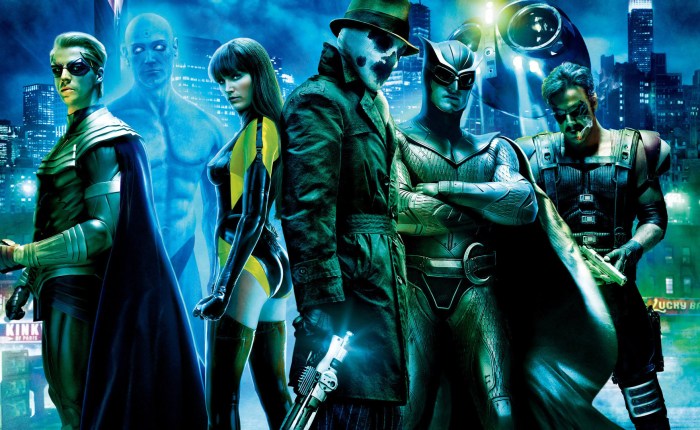
Zack Snyder has the daunting task of carrying the weight of the DC Extended Universe on his shoulders. He’s no stranger to mammoth tasks. Previously he took on the burden of making the “un-filmable” Watchmen.
Nothing is un-filmable. It’s snobbery on the part of the graphic novel’s creator, Alan Moore, to suggest so. And pretentiousness from his fans that purport the myth. Far more complex and esoteric pieces of literature have been successfully adapted for the big screen.
It’s understandable that Moore would be precious over something he had poured his heart and soul into, but it doesn’t mean he is right. Stephen King hates Stanley Kubrick’s version of The Shining. It doesn’t mean it’s a bad film; it’s just not King’s.
Alan Moore has gone on to explain he wanted the comic book media to express the advantages it holds over other forms. That some elements were designed to be untranslatable. This has truth, but equally, film can engage in unique ways too.
The challenge was to remain faithful to the source material without allowing it to be a hindrance. Zack Snyder passed this test.
Many of the criticisms are how it is too mindful of Moore’s graphic novel and works too hard to appease its fans. Many of these disenchanted voices will then draw up lists of glaring differences between movie and book.
While it’s true some back story is simplified, it’s never to the detriment of the plot or flow of the film. If anything, it aids the story in this format. It can’t be a graphic novel so it has to be the best movie it can. We still see a world on the brink of a cold war nuclear attack.
The outlawed superheroes still reveal personal connections and the flashback sequences never clog up the plot. They allow the viewer to form strong opinions before having them challenged. The Watchmen – the last team of superheroes – was an offshoot from the golden age of hero, represented then by the Minutemen.
Characters, such as The Comedian, crossover these two time periods. It is his murder at the start of the movie, by an unknown assailant, that starts a series of events that brings the old team out of the shadows.
The early drive for this is the complicated Rorschach, played by the excellent Jackie Earle Haley. His ink blotted mask, that alters throughout scenes (hence his name) goes looking for answers to a mystery that has bad ramifications for his old partners. Someone is taking out old superheroes. And he’s getting close to the facts.
The mix within the team aides Snyder in creating a good dynamic between the characters. The second Nite Owl, played by Patrick Wilson, is a guy that hasn’t acclimatised to the everyday life. In the movie they don’t quite show him as deficient as in the graphic novel but it’s clear he feels out of sorts with his existence.
His routine enables him to drink with the original Nite Owl and reminisce about the old days. He was Rorschach’s partner but sees this oddness different to his own isolation. No longer Nite Owl, Daniel Dreiberg is the opposite of Adrian Veidt, the former hero: Ozymandias.
He is the only retired superhero to declare his former role and has marketed himself based on this fact. In a satirical story, he is the most obvious jab at the standard comic book genre.
What brings Nite Owl/Dreiberg out of retirement is his connection with the second Silk Spectre/Laurie Jupiter. Malin Åkerman brings the greatest degree of humanity to the film with her portrayal. She is in a relationship with the omnipotent Doctor Manhattan – the only character that has true superpowers.

If Superman makes men look like ants, Doctor Manhattan makes the Last Son of Krypton look like an amoeba. Living with a godlike creation, has Laurie as lonely as Dreiberg. They team up to roll back the years and hunt for facts.
To say more would be to give away twists and turns, all of which, Snyder handles with ease. A thing that shouldn’t be shrugged at when considering Alan Moore’s claims.
Certain plot points are altered, but only for the better. The finale is more intelligent in both looks and delivery, and has greater human repercussions over the way it played out in the graphic novel. Snyder also provides memorable scenes. Would Doctor Manhattan’s speech on Mars to Laurie have had such an impact if Snyder was so far wide of mark? Absolutely not.
Long before Deadpool made adult superhero movies cool, and the thing studios wanted to aim for, Zack Snyder achieved the feat with an underrated and overlooked classic. Long after the Marvel Cinematic Universe and the DC Extended Universe have been rebooted until they’re burnt out and dead, Watchmen will still stand as a testament on how to approach the genre on the big screen.
 The Reflective Page