Constructive Citycism

Constructive Citycism

Manchester City have become a football club that appear easy to dismiss out of hand when they are playing well, quick to tear apart if their form dips, whilst questioning every non-footballing action through a harsh microscope. Within the club’s own fanbase the line between offering constructive criticism and being a supporter has blurred. Let’s take a look at the factors that don’t add up.

First off I’ll deal with the least favourable portion of the chat: City’s own fans. Lately there has been a generic response from certain supporters to question anyone that dares highlight an area where the team could be performing better. The usual Action Man pull-string line sounds something like, “Remember that we used to be shit.”
MCFCRelegated

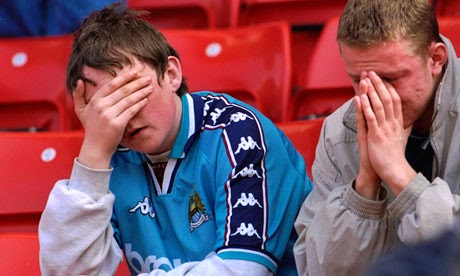
This is something that can’t be argued. But I doubt that these fans were walking away from Maine Road hiding their disgruntlement in those darker days. I dealt with the pain during the infamous season in the third tier of English football by having an extra pint at half time. Over said drink I’d criticise the players as I saw fit. It didn’t mean I wasn’t 100% behind the team, but to fail to see areas, and then comment, where the club should be better is playing the role of a blinkered fan.

I’d never boo a City player, I don’t think I even groaned like some with Lee Bradbury, nor would I offer an in-depth dissection of the team in the wrong public forum. But between fellow City fans there’s nothing wrong with pointing out where it’s going awry or which player needs to offer more. I’m not saying we should forget those bad days – they make me all the more grateful for the present – but to lean on them and ignore shortcomings shows a lack of ambition. We’ve moved on as a club and with that the mindset has to evolve.

This brings us to the next area of concern: The way we are perceived by others. Nowadays if a City fan shows any degree of confidence he is labelled as arrogant. That he has somehow forgotten that City was once a non-threat. And yet at the same time the opposing voice will point out that City should be winning because of the investment spent on the squad. It makes intelligent debate impossible when so many are unfairly gunning for the blues.

Much is obviously made about the money spent. My views on Financial Fair Play have been written here many times so I’ll spare retreading old ground concerning this oxymoron. Needless to say the detractors appear happy to see City fined and squad restricted in Europe this season, without ever explaining why the double standards within FFP are acceptable to them.

When City was playing catch-up, thus spending heavily, the process was demonised in the press. The very same press that wrote in terms of endearment and excitement when Manchester United splashed the cash this summer. Even now they report with growing arousal that they will continue the splurge. But they’re allowed because it’s their money, despite being in debt and City don’t owe anyone a penny. Other teams are applauded for business choices that bring about investment from foreign markets but City are viewed with suspicion for adopting new methods like sister clubs.

MCFCAS

The double standards do not stop there. Much is written about how excessive spending is killing the youth system in England. Yet the ambitious academy City has recently launched wasn’t met with the same fanfare as one at United or Anfield would have been. Sheikh Mansour’s best intentions are conveniently under-reported, areas open to interpretation overplayed. If any doubt exists to United’s youth development we are reminded about the class of ’92, as if it’s the only measuring stick, still recent and relevant.

If this now appears like negative comments to detract from facts it’s barely worthy when placed alongside the professional examples. Many articles written nowadays are undoubtedly click-bait for the masses. The tabloids will be targeting groups they believe have larger numbers, like Liverpool and Manchester United fans. This is fine if the articles are club centric and not written to the detriment of others. Instead the click-bait stories are often written in a manner directly attacking competitors with tripe. The chosen teams are protected and given weekly prayers the press hope are prophecies; the unfavourable clubs are knocked down and written off without consulting the available evidence.

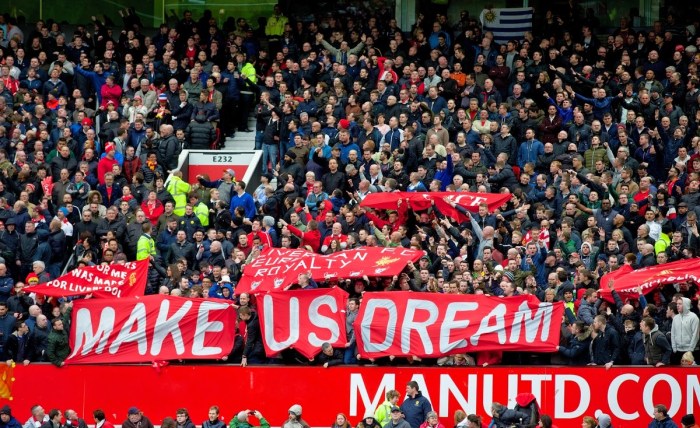
For the last two Premier League seasons the UK press has awarded the title early. Liverpool secured it with a month to spare last season, this year the Chelsea Invincibles took the title in November. Liverpool was lauded last year, as if the third highest spenders in Premier League history had never spent a penny, that Brendan Rodgers was a demigod and they “deserved” it. Pellegrini went about business like a class act, without ever receiving credit for hard work and the correct choices that brought about City’s most successful season.
LFCDreaming

This season we now sit on twenty games played, City and Chelsea have the exact same record, nothing separates them other than alphabetical order. But it’s still Chelsea that play the role of the chosen ones. Stats aside, because there’s no real split there, it’s hard to understand why the press and media are so quick to dismiss City. While they are busy romanticising over Mourinho’s team they aren’t asking the appropriate questions.

Had the two teams been tied at New Year but it was Chelsea that had suffered the loss of all available strikers throughout December, with their best one still out for a few more weeks, and John Terry had been out the side, then the anticipation that they would go on to secure the title once they were back to fitness would make sense. However, it’s City that have battled on with depleted numbers but for some reason this hasn’t been placed into any equations. Nor has the probability that at some point Chelsea are likely to lose major players. We know how City respond with men down – they close an eight point gap. How will Chelsea fare when they lose big names for long periods?

Chelsea are still spoken about as some unstoppable force, a City side carrying significant injuries is sneakily brushed aside. I’m not saying the press shouldn’t report City’s weaknesses, but they should be placed into context. Any areas that could be better only serve to show just how strong the best parts of City’s play are. Everyone is a harsh judge during Champions League games but Liverpool limped out of a weaker group without nearly as much inspection.

The press need to stop the pathetic click-bait, crowd mongering when it comes to Manchester City. Every team deserves to be given the same fair crack of the whip. And City fans need to stand together without forming fragmented groups just because of differing opinions. All we need is constructive criticism. Save the blinkered droning, combined with sickening courting by the press, for other teams.


Which E-Reader should you choose?

Which E-Reader should you choose?

At first glance it appears the only logical answer would be to choose a device from the Kindle range. After all, Amazon now reportedly has 70% of the e-book market. Despite this there is still a range of alternatives. The decision now may not hinge on which model has the best technology inside, but the one that comes in at the right price with acceptable functionality.

KindleVoyage

First off the bat it should be made clear that for pure capabilities it seems that the Kindle Voyage has further stretched Amazon’s lead in the tech stakes. It comes with 300dpi and is crammed with lots of Amazon features like X-Ray, Vocabulary Builder, Page Flip (allowing you to skim forward without losing your place), Whispersync and a whole load of other neat features, many of which are present in other Kindle models. The Voyage comes in a hefty price compared to its competition, £229 for the 3G model, which places it as the Apple priced product in the e-reader world.

Book lovers aren’t sheeple like fans of Apple products. Undoubtedly, some will buy the Voyage just to have the latest model; most will look at value for money. The arrival of the Voyage has brought the price of the other E-ink Kindles crashing. The entry model is now £49, the Paperwhite from £99. It’s these that we’ll compare to the competition, namely the Paperwhite.

It comes with a backlight, so bedtime reading is made easy, and has many of the features that the Voyage has, like the Vocabulary Builder. The integration with the Kindle store is seamless, and when navigating through the device’s books, options, highlighting passages, checking words and Wikipedia, it is smooth. Any lag is barely noticeable, and forgivable with the neat presentation. The Paperwhite does everything asked of it and avoids criticism. When you consider the Kindle store rules the marketplace, and the device itself beats the competition point-on-point, it’s the safe choice.

Being tied to the Kindle Store needn’t mean you have to use a Kindle. I would never encourage piracy, authors need all the sales they can get to ensure the future of books, but I believe e-books, like MP3s, should be purchased from anywhere to be used on whatever device we choose. Calibre is an e-book library manager, think iTunes interface without the store, that with certain plug-ins allows DRM to be removed from books. It also converts the type of format, so Kindle’s KF8 can be changed to ePub for use on Nook devices. It’s worth noting to remove the DRM you’ll need to load it from a Kindle device, mobile apps do not count, it has to be from an e-reader.

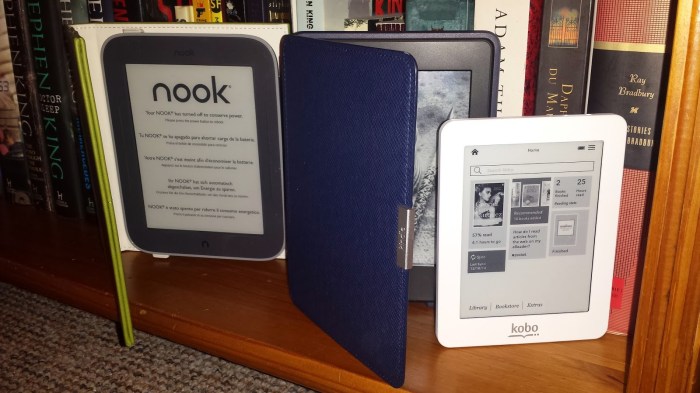
This brings us to the Barnes and Noble option. The Nook GlowLight offers a backlight like the Kindle Paperwhite. It comes in at £69, making it £30 cheaper, even after Amazon’s price cuts. A side-by-side tech comparison and you’d think the devices were pretty much identical. I initially used the GlowLight after using an old Kindle Keyboard and it felt like a step-up. And for some time there was a feeling it was a more pleasant reading experience than the Paperwhite. Until the gloss started to fade. The backlight technology is better executed on the Kindle and never once on any Kindle device has formatting been an issue. The same can’t be said for the GlowLight, sometimes it feels scrappy around the edges. However, at a third cheaper, it is a strong option, but being trapped in the Nook ecosystem could cost you more in the long run.

Kobo are the other main company out there. They offer a waterproof device that will appeal to those accident prone, bath-time readers or beach-bound holiday types. This feature, the first in the e-reader world, gives the Kobo Aura H2O a unique selling point. It also beats the Paperwhite on resolution and dpi. Again, the main negative will be the exclusion from the Kindle store, although the Kobo store is regularly priced competitively. It’s another device in the Kobo range I’ll draw your gaze to. The Kobo Mini.

Unlike other readers, this one aims small, not trying to sell spec but size. It has an 800MHz processor compared to Kobo Glo’s 1GHz and lower resolution. It is featureless in comparison to the Paperwhite. Yet, none of this matters.  It’s able enough for simply reading books. The latest update has given it a snappier main menu screen. It plays, amongst others, both ePub and mobi formats. And it fits easily in a coat pocket. Whereas one may be too precious with a more expensive e-reader, the Kobo Mini can be taken on train journeys or the daily commute without a care in the world.

Kindle Nook Covers

It’s here where the device holds a special advantage. Mobile reading apps are okay but the average smart phone drains battery fast without spending hours reading on them. The Mini can make any journey or lunch break pass without a fear of losing or damaging hundreds of pounds worth of equipment, whilst saving your phone’s battery. Even on the lowest page refresh rate it never shows its lack of power. Officially priced at £59.99, bargains can be found. I got mine for £30, including £10 store credit. Its discreet size may appeal over larger devices, that invariably you’ll buy a case for (the Nook case looks like a traditional book but is more cumbersome, the Kindle fits snug but the official cover is priced at £25).

Ultimately the main choices come down to: raw power and features, this is the domain of the Kindle Voyage or the Kobo Aura H2O. If you don’t need waterproofing then the undisputed winner is the Voyage. For an overall experience, at a reasonable price, the Paperwhite has no equal. You’ll be using the world’s main e-book library on a device that gives a flawless experience. The Paperwhite is the safe and sound choice. If you care little for the extra features and only need one for daily trips on a tram, train or bus, the small Kobo Mini might be the one for you.

More than just Leftovers

More than just Leftovers

The Leftovers starts with the premise that 140 million people have vanished from Earth. Going into the show, knowing this, one wonders why such a rapture event has taken place. It soon becomes evident that the people left behind are the focus, not the event itself. The stage switches to one small area, the fictional Mapletown, New York. Their loss creates our philosophical gain. It’s not a case of why the souls were taken, but how those that remain cope.

It should be pointed out that The Leftovers may dangle the mystery of the missing people, and furthers the unknowns by various presumed supernatural elements, however, the show doesn’t exist to answer these things. The missing 140 million is a plot device, a side issue that requires no further explanation. To do so would undermine the journey the characters take. There have been criticisms levelled at the lack of resolution, these viewers have missed the heart of the tale.

Some of these disenchanted voices have probably readied the Damon Lindelof put downs. These are the ones that hated the Lost finale and how questions remained throughout that show’s six season run. Other than his input to both shows they bear no comparison. Lost required closure on the great unknowns, The Leftoversnever promises this. This show is about examining the human condition. Any show that is dealing with existentialism doesn’t need to feed the mainstream gimmick of dropping clues and offering weak replies. It can leave that to Under the Dome (great book, bad show).

Mentioning another popular show from a literary source, it should be noted that the author of the original novel (also entitled The Leftovers) Tom Perrotta, worked alongside Lindelof to create the show. The first season covers the entire novel so season two will be new material, and again, he is heavily influencing this. It’s refreshing to see the source material being used extensively.

The depth in the writing is brought about by an excellent cast. Christopher Eccleston once again proves his vast range as the town’s man of faith who attempts to prove the people taken in the sudden departure were sinners. Watching him wrestle with faith compliments the show’s main centrepiece, the cult named the Guilty Remnant. They are silent watchers, heavy smokers, and easy to despise pests. In forming this opinion it makes one wonder about the real world situation the metaphor represents. Why do we hate the unknown element? Some of their actions appear unforgivable but nobody is coping with the loss the world has suffered.

Leftovers

Justin Theroux plays the shows lead, and town Chief of Police. His wife has left to join the cult and his son is running errands for the Peep Show’s Johnson, who is a spiritual leader of sorts. His already full plate is further filled by a rebellious daughter and a father, the former Chief of Police, that has been committed for mental illness. This in turn makes him fear his mind is also on the slide. He starts to date Carrie Coon’s character, Nora Durst, a mother of two whose whole family was taken in the disappearance. Her character centric episode reveals the great depth she has as an actress and the writers’ efforts to layer her.

These are just several standouts of a stellar cast. Each keeps the show rolling forward with grit, pain, and precision. They aren’t used to answer the question of why the rapture event took place, we just accept the Pope and J-Lo were taken as easily as the select members of the town, they do make us examine where the world is heading. Hopefully season two will continue to explore these leftovers rather than explain the ones that departed. There are some mysteries that should remain beyond man. All we can do is look internally to see what we find there.