There are moments when it’s possible to realise your favourite thing isn’t objectively the best example. This applies to media that ultimately require a subjective take: favourite song, favourite food — favourite movie. Batman has appeared on film in many guises now. From the camp Sixties variant, to Burton’s 1989 revival, Nolan’s Heat-inspired Dark Knight Trilogy (although, that inspiration only applies to the second outing), a gritty, ageing Caped Crusader in the Snyderverse, and the Matt Reeves take on Year One Bruce in The Batman.
Of all the reboots and relaunches, this writer’s desert island Batman movie is Batman Returns.
It’s not objectively the best film out of all the ones on the list. Others achieve better visuals, cinematography, storytelling, performances, soundtracks, scope. But great ingredients still need the correct conditions and the right chef. Batman Returns remains the one Batman movie that has stood the test of time because Tim Burton’s style brought all the ingredients he had at his disposal to something the world either wasn’t ready for, hadn’t been expecting, or misunderstood.
A regular criticism of Batman Returns – one which even fan sites repeat – is that it’s a Tim Burton film, not a Batman film. Sure, his particular style is familiar. To be less kind, you could say somewhat formulaic. Edward Scissorhands shares its DNA with Charlie and the Chocolate Factory, and Beetlejuice. Part of that shared code is Burton’s proclivity for gothic fantasy.
In The Dark Knight’s case, it wasn’t Burton imposing his style on Batman: it was revealing a shared understanding. What is more gothic than an orphan becoming a bat-shaped vigilante under the cover of darkness? Or a woman cheating death and becoming cat-like? And a baby discarded and raised in the sewers beside penguins?
Dark, gothic, and delivered akin to Legends of the Dark Knight, a monthly comic which showed a more off-kilter version of Batman and Gotham.
And let’s look at Gotham. A city that existed in Batman lore long before Burton placed it on film. He didn’t put the Goth into Gotham; he was merely a tourist capturing the moment.
The criticism of how the film has been perceived doesn’t just end with the flawed Burton argument. From fans to marketing partners, there was a disconnect because people’s predisposed ideas created a gap between the film and their expectations of what a Batman movie should be.
Looking back, it’s hard to understand why there was such a disparity. Batman may have been more avant-garde than what we eventually saw in Batman Returns, but it was clearly aimed at teenagers and above. It was the first general cinema release to receive the 12 certificate, before being classified 15 for home video. So it has to be said, Warner Bros. were idiots for entering a Happy Meal deal with McDonald’s for its sequel. That’s what Batman & Robin exists for, Returns was never going to tonally become a kids’ movie. The association with a Happy Meal meant people complained louder about its darker themes and violence. It was set up to be viewed through the wrong optics from the start.
Negative press aside, why does it – on its own merit – deserve the crown of Desert Island Batman Movie?
Burton’s second take on Gotham completely shifts from the Art Deco we saw in Batman. This is a Gotham submerged in snow and the otherworldly. It doesn’t attempt to be a twisted New York. This plays like a tiny microcosm of the bizarre, damaged, fantastical, and corrupted. A fairy tale of Batman versus versions of himself he could have become. It isn’t Batman does a Burton, it is Burton inhabiting Batman.

The set-up is simple enough: a baby so grotesque in deformity is placed in a basket and thrown into a river. That baby is Oswald Cobblepot, The Penguin. He emerges from the shadows as a lonely orphan turned accidental hero. The world doesn’t know he staged the scene but Gotham takes him to heart. Its other heroic orphan has suspicions. To pull off the deceit, he blackmails Christopher Walken’s Max Shreck, a wealthy businessman and also the centre of Michelle Pfeiffer’s origin story as Catwoman — he kills her (don’t worry, cats revive her into Selina’s comic book form) because, as a shy secretary, she reveals she knows too much.
Later on, it became the trend for superhero movies to overload with multiple bad guys. It killed Tobey Maguire’s run as Spider-Man. Here, it works perfectly. No one is included for the sake of having the character in the film. Danny DeVito nails The Penguin with more one-liners than Jack Nicholson managed for the Joker. Walken provides the cement in the evil chaos and then there’s Pfeiffer.
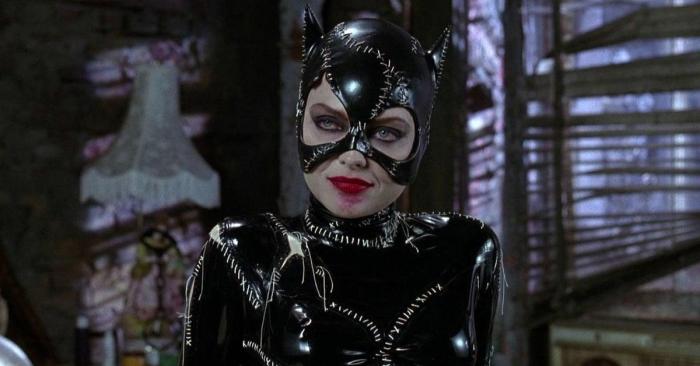
People can debate the best version of the Joker. Some versions won Oscars, others were the standard for decades. Colin Farrell has opened up the Penguin debate. Best Batman is a title that will likely never be universally agreed upon. But Michelle Pfeiffer is the definitive Catwoman. No one has come close over the years, and what underlines the point more than anything is there have been very strong performances elsewhere. But Pfeiffer is Catwoman.
Across from these three towering figures, who take it in turns stealing scenes, is Michael Keaton’s Batman and Bruce Wayne. In the 1989 movie he announced himself to the world with the answer: “I’m Batman.” In Returns he becomes Batman. From the moody shot of him waiting for the Bat-Signal to light up his room in Wayne Manor, to the way he holds steady when all around is falling apart. The scars of his life, and loss of love from the last movie, to the dynamic with Selina Kyle when she’s not in Catwoman leather, he is a complete Batman.
This is where the film’s excess starts working in his favour.
The absurdity of a man dressed as a bat, fighting crime at night, falls away in a world where DeVito’s Penguin becomes mayor and Pfeiffer licks herself clean in her catsuit. It allows Batman to be stripped back to the World’s Greatest Detective motif. He’s the solid structure facing an increasingly crazier world. With the suspension of disbelief required for a gothic fantasy, Keaton’s Batman becomes the logical choice for saviour. No fan ever read a Batman comic and called into question a latex-wearing vigilante. They don’t here because Keaton encapsulates that character in an environment that allows him to exist in the cape and cowl without explanation or justification. Nolan needed almost an hour of film to show his Bruce Wayne training in the League of Shadows after fleeing Gotham. He does forge a believable Batman, it just required a lot of exposition. Burton only needed to put Batman in his true home; no more questions required.
Time hasn’t tainted what’s captured and even if the nostalgia coefficient is applied, there are iconic moments that, when added together, a modern-day franchise would be proud to have collated. They appear here in a singular film. Pfeiffer’s transformation, her changing the neon apartment sign from Hello There to Hell here. Using her whip in the department store, a shot she tirelessly performed herself until perfected. Penguin’s “At least my nose isn’t gushing with blood,” or “I have a name, Oswald Cobblepot,” and “Burn, baby. Burn.” The list of quotes across all characters could fill a few articles. It’s pretty much the bulk of the script.
The “Things change” face-off.
So many modern movies fall under the weight of the third act. The Batman loses the early credit it gains by going too big with a massive ramping up of the stakes. It was too much. Batman Returns keeps it simple. Penguins with rockets equipped. Nothing overly complex; the characters are already layered enough.
For all the moments that should be absurd – but work in this setting – we still have heart. A Bruce Wayne seeking companionship and a way out with someone he knows is flawed but can also see how character is formed in 50/50 moments. His faith in the good he sees in Selina, enough to give up the mantle of Batman to save each other. A surreal movie with so much dark comedy, the fact it still has humanity shows it was doing everything correctly. Perhaps its biggest mistake was doing it too well. Marvel movies like to spell out every emotion. DC – until James Gunn’s new era – generally were darker and relied on the audience to read the subtleties for themselves.
Batman Returns is a movie that delivered on every level, but was sadly overlooked. Batman changed the way superhero movies were perceived and made. Nolan’s trilogy changed them again. Marvel demonstrated how to make a cash cow from IPs. Those last two shifts mean it’s unlikely we’ll see such a complete standalone comic book movie again. They will either try to be too serious, or too mainstream.
Batman Returns was dark, but light. A blockbuster ensemble for a niche audience. Guilty, perhaps, of giving people what they say they want, only to reveal that what they want and what they are willing to accept are not always the same thing.