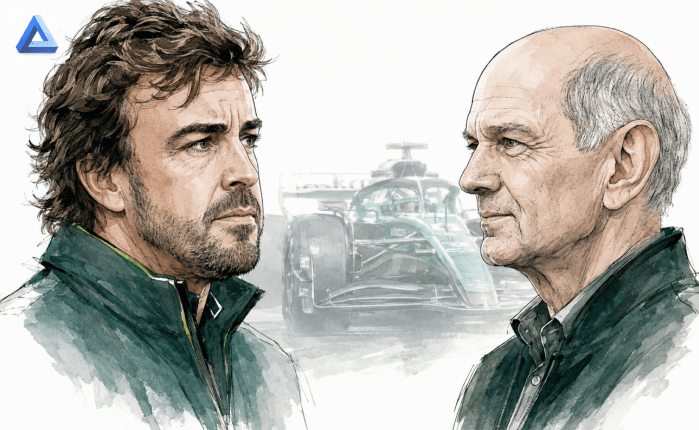
There are only a few certainties in life. Death, taxes, and Fernando Alonso being in the wrong car at the wrong time. Three years ago, it looked like the infamous Alonso Curse could be lifting. Aston Martin was starting to see front-of-the-pack action. Alonso was on the podium the first three races of the season. Had a time traveller told you back then that by 2026 Alonso would be in an Adrian Newey car, you’d be expecting him to make space in his trophy cabinet for a third world title.
Just the notion of them being in the same team would have sounded far-fetched back then. Newey was Red Bull for the rest of his career. Until Christian Horner became the focal point of a team split. Newey was lured across by more than just Lawrence Stroll’s money (that undoubtedly helped). He was given an active role in shaping more than just the design of cars. He’d be a shareholder and a person with genuine authority. Aston Martin had shiny new facilities and a good track record of investment.
Newey said he needed a new challenge. The option Ferrari presumably offered was his old role in red overalls. Aston Martin may have – initially, at least – overextended Newey. Attempting to put his Midas touch on everything within reach. He was announced as the Team Principal, only for that role to blur and slowly retract as his position as Managing Technical Partner was reaffirmed. Newey is the most successful F1 car designer of all time. It doesn’t mean he can run all technical aspects and the race weekend to the same exacting standards. The attempt to do so will only create a dilution of excellence elsewhere.
This isn’t to say Aston Martin have struggled this year because Newey was spread too thin. A ghost from Alonso’s past – Honda – played a very large part. Honda was reunited with Newey in name, but it now appears many from the Red Bull Honda days had moved on, believing Honda’s time in the sport had elapsed. What Lawrence Stroll made a deal with was a Honda F1 reboot, not the version responsible for Red Bull victories.
It wasn’t just a performance issue with Honda. The vibration was so bad from the integration between engine, battery mounting, gearbox and transmission that Lance Stroll and Alonso limited their running time in the car to avoid permanent injury. But Alonso has been living with the curse for so long, not even this rattled him. The 2017 Honda engine at McLaren suffered from vibration issues. These resonance issues would induce electrical faults after shaking components beyond their finite life. The 2026 sequel was all that and more.
Alonso has largely taken it in his stride. He speaks of being at peace with his career, his achievements. It would be wrong to disbelieve him. Age brings about calmness and reflection. It only becomes a problem for a driver when it dampens down the fire too much. For Alonso, there are signs it still burns fierce. He spoke before the season that he’d be more inclined to carry on if the 2026 car wasn’t perfect, if there was still a challenge. His career choices have led him into situations where victories don’t come with trophies, but achieving the impossible in flawed machinery.
He still faces that challenge at Aston Martin.
But he also knows time is starting to run out for one last taste of victory. When he declared the Barcelona Grand Prix could be his last, it revealed he is uncertain when he’ll call time on his career. A new contract with Aston Martin has yet to be agreed and his old friend at Alpine, Flavio Briatore, has been linked with recruiting Alonso.
It has all the ingredients for one final, poorly timed, Alonso move. On paper, Alpine may make some sort of sense. They’ll be using Mercedes power in 2027 and that currently looks like the most tempting engine bet on the grid. The team has a big new title sponsor: Gucci. Alonso and Gucci go well together.
All the signals also align with fulfilling the final phase of The Curse.
He would be leaving Aston Martin at the exact moment a true Newey car is unleashed on the grid. This year’s variant is part-Newey, with Newey himself split into too many parts. The 2027 car is supposedly all Newey. Who wouldn’t want to get behind the steering wheel of that?
We’ll find out if Alonso rolls the dice one last time and finally gets a good hand. There is no perfect choice. A Newey design doesn’t guarantee a title. Lewis Hamilton’s haul attests to that. But being in one certainly improves your chances. Max Verstappen, Sebastian Vettel, Mika Häkkinen all won multiple world titles in a Newey car. Nigel Mansell, Alain Prost, Damon Hill and Jacques Villeneuve all took one apiece for Williams. Having Newey design the car gives a driver a strong hand.
Those four Williams titles highlight an Aston Martin trait that appealed to Newey and could convince Alonso to stay. Lawrence Stroll is seen by Newey as a genuine throwback. He’s seen as an active owner, in the style of Frank Williams. Stroll is giving Newey the keys to the kingdom but he’s not an absent, faceless money man. Alonso has a good relationship with Briatore so there’s a romanticised version where he has one last Enstone chapter.
Whatever he chooses next, it won’t be for “the challenge”. Being at the back of the grid for the whole of 2026 is challenging enough. It will be where he thinks – on the balance of probability – he stands the best chance of seeing a race win again. His options are clear: Mercedes power versus Newey design.
It’s the sort of decision that comes down to a coin toss. A 50/50. Within that choice is another factor that could swing the pendulum back to Aston Martin. At Alpine, he would likely be paired with Pierre Gasly. That would be a notable step up from Lance Stroll. Suddenly, he could be facing the George Russell dilemma: fight for a drive in the fastest car (not that the Alpine is expected to be this, but it will have the best engine) only to be outperformed by your team mate.
If Newey delivers a race-winning Aston Martin, it will be Fernando, not Lance, claiming those wins. If the Alpine becomes competitive, it’s plausible Gasly reveals the effects of Father Time on Alonso.
Which turns the 50/50 choice into a three-way split.
He could retire. After years of unfortunate timing in the transfer market, he may well decide he can’t face the prospect of another long year of uncertainty – or worse – watching the car he could have been in outperform the one he chose every race weekend.
Of the three choices, retirement is the one this writer fears most. Alonso has a claim to be the best driver of his generation. He’s now with the best designer in the history of the sport. It would be a shame not to see how it plays out. Even if the progress is slow to start, a Newey car with some Fernando DNA sounds like something worth sticking around for. It seems almost impossible the results wouldn’t eventually follow.
Curses can be lifted. Newey could well be the man to perform an exorcism. If it’s just poor timing and coincidence, probability states he has to make the right choice at some point.
If it’s just good old-fashioned luck, he’s due a bit before he hangs up his helmet.

 The Reflective Page