The Exorcist

The Exorcist

The start of a Halloween weekend sees many turn to their movie collection to dig out the best fright-fests. This invariably leads to discussion that asks the big question: What is the scariest film ever?

The answer from these quarters: The Exorcist.

As firm as that answer will always be, so is the chance it’ll find disagreement. Since its release in 1973, the horror genre has gone through many reinventions in order to maintain appeal. The search for shocks, of the jumpy kind or those that push the boundaries of what is acceptable to show on film, means the psychological chills have seen less usage.

Sure, The Exorcist wasn’t averse to special effects designed purely for a gasp, and to test the viewer’s constitution, but it’s credit to its real scares along the way that these still stand-up. Admittedly some have lost their immediate power after years of being parodied, either on purpose by the likes of French and Saunders, or by cheap copy-cat horror productions looking to recreate some of the magic.

Those untouched by the movie are the ones most likely to dispute the existence of life after death. But if you spend your days praying to a force for universal good – or just believe there might be something after death – then playing with the notion of a bad side becomes unsettling.

The build to the evil emerging is a deliberate slow step. In the opening scenes we witness Father Merrin unearth a token in Iraq, signalling a demon has returned. This backstory is developed in other media, here we just get a hint and he later alludes to it himself.

A skip to Georgetown and we are introduced to the life of famous actress Chris MacNeil (played by Ellen Burstyn) and her daughter Regan. What is most remarkable about Linda Blair’s performance of the twelve-year-old is that any evidence of over-acting can only be found in the pre-possession scenes. Before the demon is inside her, the acting is cringe worthy. But once she is asked to perform as a possessed human, it’s far too believable.

The seemingly innocuous occurrences ramp-up until Regan herself displays changes in behaviour. Being famous comes with suspicion. It’s conceivable a daughter exposed to the Hollywood lifestyle would have a sense of theatrics. When Chris seeks help from local priest Father Doctor Damien Karras (double titled to highlight he is also a psychiatrist), he even asks if Regan could have accessed recreational drugs.

The Father is assured that hasn’t occurred. What let the demon in was Regan playing with a Ouija board. But the case comes at a time he has lost his faith in God. This morphs once he begins to believe Regan could be possessed for real and it’s not a disorder, fake or a result of being exposed to drugs or a situation.

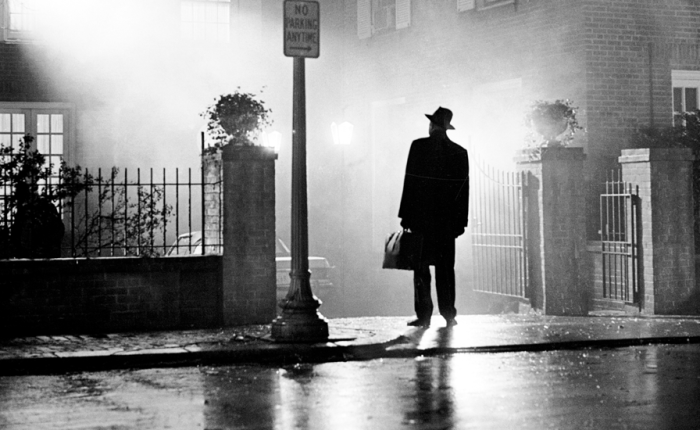
He calls in Father Merrin for assistance. The shot of Max von Sydow’s Merrin arriving on a dense, murky, atmosphere filled night is beyond iconic. If a sense of a character and his importance to a film has ever been better captured then that footage must be missing: This is the pinnacle of achieving such a feat.

Merrin brings great advice (“But he [the demon] will also mix lies with the truth to attack us.”) and prior experience. And soon begins a battle between good and evil, to a suspense filled climax.

It may sound an over-the-top reaction now, but upon its release stories of nuns sprinkling Holy Water as people stood in the queue to watch the film, added to its notoriety. It’s the sort of marketing campaign movie execs wouldn’t dare dream up. Such was its impact, those that saw it, understood why. In England, St John’s Ambulance had extra staff on standby as people passed out when confronted with the images.

Its 1998 re-release in the UK is when this writer appreciated those concerns from the seventies. Undiminished by time, it was equally as shocking and thought provoking.

By the time the famous head-spinning scene arrives, you are absorbed and truly believe the young girl is possessed, the words that follow, “Do you know what she did? Your cunting daughter?” are chilling. Far from the potential comical, dated look it should have had two decades after being made.

Remarkably, when adjusted for inflation it is the highest grossing film Warner Bros. has ever released. It explains why they were quick to call for a sequel but makes one wonder why the successful formula was abandoned. More surprising is how no movie maker has ever gotten close to replicating the style.

Usually when a movie gets rated number one in a genre, it is revisited on a fairly regular basis. The Exorcist is the exception to this rule. Even though it’s a horror movie and this is Halloween season (and the eagle-eyed viewer will note the story takes place over Halloween) it’s not one I’ll be revisiting any time soon.

After seeing it in the cinema during its 1998 run, three weeks of nightmares followed. A little older now, after a viewing this can be reduced to three uneasy nights.

Until such a time the demon can be faced once again, the aim is to try and enjoy “Tubular Bells” as nothing more than a piece of music, not associate it as the perfect soundtrack to the perfect horror movie.
Is DC committing Suicide?

Is DC committing Suicide?

Suicide Squad befell the same fate as Batman v Superman: Dawn of Justice. It started strong at the box office before second week drop-offs compounded negative reviews. In an age where everyone is a critic and the professional critics are ignored, it appears the dissenting voices are the loudest. With further doubts raised about the DC Extended Universe (DCEU), is the Warner Bros. led property starting to implode?

Before the cameras even started to roll on Batman v Superman, DC and Warner Bros. had their work cut out. They faced the unenviable task of chasing down rivals Marvel. The Avengers led superhero cinematic universe is a magnet for two things: cash and compliments.

Both of these can be attributed to the accessibility of the Marvel movies. From the opening feature in the Marvel Cinematic Universe (MCU), Iron Man, they have made no attempt to hide the comic book roots from which they grew. They have been easy going action films, driven by simplicity.

The peak was arguably The Avengers (or Avengers Assemble). It would have been easy to crowd the film with too many main players but Joss Whedon pulled it off using a blend of humour and a clear plot.

This love has allowed Marvel fanboys to escape the negative points within the MCU. Those that were quick to pounce on Suicide Squad are not so quick to discuss Iron Man 2.

Therein lies a fundamental problem: DC haven’t been afforded the time to find their footing or been allowed to develop their own style. They are judged harshly for not being Marvel, but equally derided if any element of the DCEU mimics the MCU.

Historically, DC films have carried a darker tone (we’ll ignore Catwoman) or more recently with Christopher Nolan’s Dark Knight Trilogy, been grounded in something closer to reality.

Man of Steel and Batman v Superman approached the arrival of superheroes in a more realistic manner than Marvel ever will. When given the chance to explore these themes in Captain America: Civil War, Marvel shied away. Unfortunately for DC, being a superhero flick in a time the market is over saturated, means they aren’t judged on their own merits but compared to the market leader.

And this is where DC seem to be turning the gun on themselves.

A dark tone can be well received, Nolan’s trilogy was hardly a mainstream cartoon like The Avengers, so DC were right to start their movies with a more serious undertone. The problem is, dark for dark’s sake is draining on viewers. Without substance it has a depleting effect rather than become tone setting.

That objectively observed lack of substance isn’t down to DC characters having an inability to explore larger themes, it’s because parent company Warner Bros. are being swayed to the Marvel mainstream.

This leaves them in no man’s land.

DC wants the popular Marvel share while retaining a more meaningful scope. It can’t do both and the cracks are beginning to show.

Suicide Squad was another film that some critics went after in a big way. Most of those observations were unfounded or unfair. It wasn’t a muddled mess nor depressing. It was a simple action flick that ran from start to finish without a hiccup. There were enough laughs, decent action scenes and enough character introduction to allow DC to now use the villains ad hoc.

But average isn’t DC’s aim and Suicide Squad took a big step to selling out.

It was a further step away from a gothic palette and real world influences on fantasy elements. Those things were still there, but delivered with less certainty. Unless it comes across forceful and confident, DC’s vision will be swallowed up by internet trolls and critics that are judging DC based on a rival’s blueprint.

Warner Bros. will point to critics often getting it wrong. Transformers has always reviewed poorly and taken home massive returns. Same with Pirates of the Caribbean. But these films are cash cows that don’t care about artistic acclaim. DC on film should be about satisfying the comic book fans and pioneering new visions for the big screen.

Long after the current superhero phase, Tim Burton’s Batman entries will still stand out as a turning point and The Dark Knight will forever be the benchmark. If DC decides to forgo long standing values to chase down Marvel for their share of cinema revenue, it will fail on all accounts.

Unless it stops worrying about box office returns and market share compared to Marvel, it will march toward a self-induced, slow creative death, in which it may never find resurrection.

First Action Hero

First Action Hero

To say the movie market is over saturated with superhero films is an understatement. When they attempt to add depth, like Batman v Superman: Dawn of Justice, they face a backlash from critics and fans for not following the simple Marvel formula. If too many stick to the tried and tested, people become bored. Deadpool can’t be placed into either pigeon hole. So what is it?

The common line is it’s the R rated violent superhero comedy, that isn’t really a superhero film. All that is true. From the opening credits it’s clear the movie is very self-aware and the jokes are going to be aimed at everyone, including themselves. Having no fears about where the gags fly proves to be very liberating for the makers.

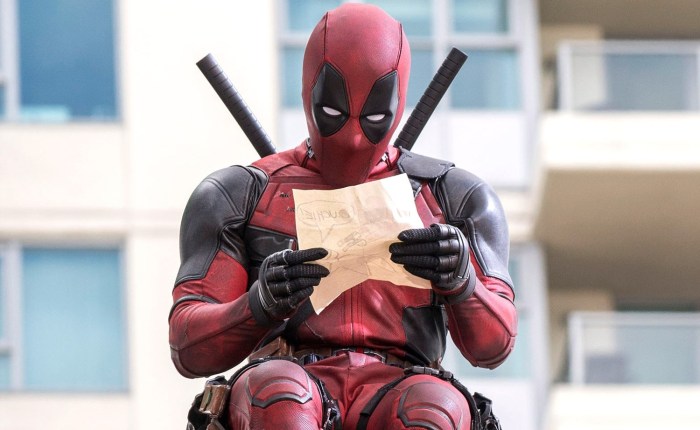
As in the comics, Deadpool breaks the fourth wall. The level as to which he does it here is surprising. When being dragged to the X-Men mansion he asks: “Stewart or McAvoy? I can never keep track of these alternate timelines.” Gags and nods come thick and fast, many leaving Easter eggs for those with knowledge of the character’s history. Others are just for pure laughs, like poking fun at Ryan Reynold’s turn as Green Lantern.

If that was his failed attempt at a superhero franchise, playing Deadpool has been his redemption. Admittedly, he’s had to take it to an adult level. This tone is set very early on. The plot moves along with the present day Deadpool flipping back to his past. There, he was in love with Morena Baccarin’s Vanessa, a prostitute he meets in his local bar.

These early exchanges between Reynold’s as Wade Wilson and Baccarin teeter on a level of cringe that would lead most movies to fail. Thankfully it lasts for ten minutes before their relationship is advanced and the more natural humour once again litters the scenes.

Having the origin story as a series of flashbacks prevents the script from stalling. It allows the laughs to flow while the heart of the characters slowly takes shape. Wade is diagnosed with cancer and then offered a cure from a man dressed as Agent Smith from The Matrix. What appears like a legitimate superhero programme turns out to be the world’s number one torture destination.

Their method is to inject a serum that stimulates latent mutant genes while exposing the subjects to high degrees of pain. The theory being stress will make the mutant strands activate to protect the host. It’s a case of death or super-powers, whichever comes first.

It’s no spoiler to say Wade Wilson survives, otherwise we’d have no film. He’s left with regeneration powers similar to Wolverine, with the ability to regrow body parts. The bad news is he is scarred to the point he doesn’t think Vanessa would take him back.

What follows is a revenge plot. He wants to find the man that caused the pain and visual damage. What stands in his way is the X-Men. Well, actually just two. Colossus and Negasonic Teenage Warhead. Their interference allows the British bad guy, named Ajax, a chance to realise who is after him and then capture Deadpool’s woman.

It’s all pretty simple but that plays to the film’s strengths. It’s not trying to be a philosophical superhero film and its adult themes means it doesn’t have to pander to the younger Marvel audience. The action sequences benefit from the removal of violent restrictions. And it becomes clear what type of film it really is.

It’s not a grown-up superhero flick. It’s a modern action film.

In the eighties, before the modern craze of super-powers and capes cluttered the box office, action men were kings. Like the westerns before, the niche market found a way to rule. Like the current superhero phase, over saturation became the norm.

Arnold Schwarzenegger, Sylvester Stallone, Jean-Claude Van Damme, Kurt Russell, Mel Gibson and Bruce Willis are just some of the big names from an era that stretched into the next decade of film making. After that, more actors took on roles in simple action movies, with varying degrees of success.

Once you realise that Deadpool isn’t a true superhero flick, the category it best falls into is action. The jokes are reminiscent of the cheesy humour people like Schwarzenegger would use. Except the humour here is noteworthy and the action sequences have caught up with the times. Long after superhero films have been shelved again, it’s easy to imagine Deadpool still fighting his way through enemies and cracking off edgy jokes.

The weakest part of the movie is how the X-Men have been shoehorned in. Obviously Wade Wilson is part of that universe, a failure to mention this would have been unthinkable. But Fox, the rights holder to these particular Marvel characters, would have been better advised to make this a standalone affair.

Their desperation to have something akin to the Marvel Cinematic Universe is a painful imitation. Deadpool should be allowed to find his place in the movie landscape, freed from the shackles he spends nearly two hours making jokes about.

Yes, he has mutant powers, but we can accept that and move on. Allow him to face foes in standardised action flicks. Leave superheroes, like the X-Men, to deal with their own impending apocalypse.