Interfering with Play

Interfering with Play

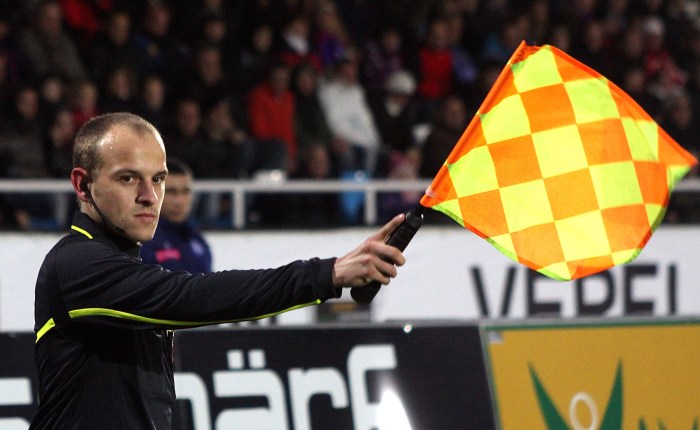
The offside rule used to be a tool used for misogynist jokes about a woman’s inability to understand a law that “real” men saw as child’s play. Nowadays, it is the rule itself that has become a bad joke.

The constant tweaking of the rule (Law 11 in association football’s, Laws of the Game) started with a desire to make football more exciting. As far back as 1925, it has been altered for this very purpose. In that year they modified the last defenders from three to two, this led to 1,673 more league goals being scored that the previous season.

There is clearly a precedent for the rule to slow the game down, with constant free kicks and breaks in play, or goals being ruled out. The modern variants of the law have centred around if players in offside positions are active. Or interfering with play. The problem is, the open to interpretation approach is what’s now interfering with play.

The rule is written as such:

It is not an offence in itself to be in an offside position.

 A player is in an offside position if:

  • he is nearer to his opponents’ goal line than both the ball and the second-last opponent

A player is not in an offside position if:

  • he is in his own half of the field of play or
  • he is level with the second-last opponent or
  • he is level with the last two opponents

Offence

A player in an offside position is only penalised if, at the moment the ball touches or is played by one of his team, he is, in the opinion of the referee, involved in active play by:

  • interfering with play or
  • interfering with an opponent or
  • gaining an advantage by being in that position

No offence

There is no offside offence if a player receives the ball directly from:

  • a goal kick
  • a throw-in
  • a corner kick

Most people that watch a game of football understand the basic principles of the offside law. The flaw with it lies in the opening line: It is not an offence in itself to be in an offside position.

This ambiguous statement evolved from former amendments that stated: obstructing the opponent’s line of movements or making a gesture or movement which, in the opinion of the referee, deceives or distracts an opponent, before changing to: challenging an opponent for the ball.

Now we have first and second phases of play, being stood in front of goalkeepers on free kicks but officials making on-the-spot assumptions about where the ‘keeper should be looking, as if they are robots that ignore their peripheral vision.

As Brian Clough famously said: “If you’re not interfering with play, what are you doing on the pitch?”

We all want to see flowing football, but not to the detriment of the laws that govern the game. FIFA will never implement a rule change allowing dangerous tackles to be ignored if a goal comes from the subsequent attack.

So why are we being asked to ignore dubious application of an age old law to assist illegal goals?

The attitude to ignore the rule is becoming quite pandemic. Everton scored their first goal against Manchester City in the opening leg of the League Cup semi-final with Romelu Lukaku stood in front of the goalkeeper. The hazy understanding of the rule means it stands with little debate.

Juan Mata scored a beautiful free kick against Shrewsbury Town in their FA Cup clash. Unfortunately, a three-man wall, placed in front of the goalkeeper, never made it back onside before the ball was struck. However, the officials believed they weren’t interfering with play. If you’re not interfering with play when stood in front of the goalkeeper, you never will be.

This attitude to ignore now stretches to even simple decisions. Wayne Rooney scored against Derby County in the previous round, after being marginally offside before receiving the ball. BBC commentator Danny Murphy declared he’d rather enjoy such a good strike than focus on whether or not Rooney was offside. So the message is clear: It doesn’t matter about the rules if it looks good.

This ambiguity needs to end. It’s making the referee and linesmen’s jobs almost impossible. Sooner, rather than later, a major tournament will be decided by a dubious call that sits in the offside grey area.

Nobody wants to see the Champions League or World Cup decided with a goal that leads to an inconclusive debate about if a player was interfering with play.

It’s time to go back to basics. If a player is stood in an offside position when the ball is played, then he’s offside. Leaving it open to interpretation places an unnecessary spotlight on a sport already riddled with mistrust and bad calls.
 

More Tragic than Magic Cup

More Tragic than Magic Cup

Heading into another FA Cup weekend the phrase: “Magic of the Cup” will be brandished about in an attempt to repackage nostalgia as relevancy. The sad truth is that the oldest domestic club competition is looking its age. Bold steps need to be taken to save the tournament becoming no different than the League Cup, or worse, a Premier League club’s equivalent of the Johnstone’s Paint Trophy.

The irony is, those two lesser cups have the answers that could help alleviate some of the pressure bearing down on the FA Cup. In How to Make the FA Cup Great Again the notion of making the fourth Champions League place available to the winners was put forward. That’s less likely to occur now than at any point previously.

The FA Cup now needs to accept its place on the priorities and level of importance list that clubs attach to it. Failure to do this will make it nothing more than an annoyance, that witnesses weakened sides take to the field as clubs rest key players for bigger games.

The quickest way to appease the larger teams is the removal of replays. Should Manchester City, a team still in all four competitions, draw with Chelsea on Sunday, they will have to find a week that has eight days to host the replay.

Manuel Pellegrini has already hinted that a weakened City side will face the Londoners, after being upset his team play so close to a long trip to play Dynamo Kiev. This is slightly cheeky considering last season the Citizens travelled to the UAE for a game only days before their FA Cup tie with Middlesbrough. When it suited the club, travelling was played down. Suddenly it’s important again.

What it does highlight is how the FA Cup is seen as a burden. It sits behind the league and European competition, and at this point in City’s season, less important than the League Cup final. The dread of a replay only further takes away any shine for the club’s management.

Making FA Cup ties one time affairs reduces the fixture congestion. It will also ensure each game is played with the true spirit of a knock-out cup game. At the moment smaller teams hang on for a lucrative payday back at a big ground rather than throw caution to the wind. This enables pampered teams to negotiate the tricky lower league pitches with a degree of danger removed.

But even teams in the lower leagues would prefer to avoid a replay rather than extend a “cup run” that, in all likelihood, won’t get them anywhere near Wembley. Survival is more pressing than chasing empty dreams.

Such is the fear of injuries and fatigue, clubs will consider dropping large numbers of the first team for FA Cup ties, the Johnstone’s Paint Trophy offers a great example of how to help clubs avoid both these problems. After 90 minutes the game should go straight to penalties.

Why give the home team the advantage of another 30 minutes on familiar soil? Save the legs and get straight to the shootout. It’s another way to increase the excitement levels and encourage maverick tactics in normal time.

Traditionalists will feel uncomfortable with the suggestion that FA Cup fixtures could be moved to midweek. At first glance, it does seem like a drastic measure. A further undermining of a flogged dead horse. However, there may be some credit to the idea.

Tuesday and Wednesday games haven’t harmed the Champions League. Perhaps the FA Cup could ride on the coattails of UEFA’s success with a competition and populate otherwise vacant midweeks with something meaningful. The only major concern – aside from losing a familiar (often bemoaned) weekend showcase – is how it will impact working class fans that have to travel on a work night.

The FA needs to consider changes like this. It’s sold its own cup down the river so many times in recent years (starting with the 1999 winners, Manchester United, withdrawing from the following season’s competition to compete in the World Club Cup) and devaluing it ever since. To carry on in the same format is consigning it to death.

No matter how many times the BBC say “The Magic of the Cup” this weekend, the truth is, this once great competition has become a footballing tragedy.

Make a Stand or Lose a place in Yours

Make a Stand or Lose a place in Yours

The stance taken by Liverpool fans against the incoming price hike at Anfield is justified and long overdue. Their decision to say “enough is enough” is a force for good that every football fan in the country should get behind. Loyalties may divide us for 90 minutes when teams face one another, but together we need to protect our mutual interests. Football is for the people and money is slowly taking it away from us.

For far too long, the cash in top flight football has been grotesque. More than ever before, supporters are aware how much money is flowing into the game from commercial avenues. At the same time, the cost of following a team has risen at a greater rate than these business success stories.

It’s as if the working class man has been under a spell. Dazzled by massive names from overseas gracing their town. Stadiums morphing into modern complexes that are among the best in the world. Commenting on their star striker’s new salary as if it’s a bonus section in Premier League Top Trumps.

Under the evil voodoo trick they have failed to notice the rich have been getting richer. Chairman haven’t been using the increased revenues to solely finance the players and new facilities. Everyone has been getting their slice and the common man has been asked to provide more. Agents and men sat in boardrooms are playing the part of the anti-Robin Hood.

The new stadia will remain a source of pride, until they are inaccessible on a working class wage and become filled with corporate fans. Sat there for multiple reasons – none of which are to cheer the team on. Next season they could be going to a different club; it all depends on where the best business is.

The working man instead settles in at home. He watches Sky Sports News fight his corner. They report the justified outrage at the increasing cost of the game for the guy struggling to afford a replica kit for his children. They are either experts in satire or fail to see the irony.

It is their outlandish £5.5bn bids that make this all possible. They balance the books by asking the struggling fan for over £30 a month to access their sports package. But that’s just a starter . . . how about HD, and broadband, and over 300 channels you’ll never watch?

It is greed fed by gluttony.

£77 for one game is the step too far every fan in this country has been made to shuffle toward for too long.

With the latest TV deal, every club in the Premier League could afford to make every single game free for fans at the match and still make more money than the current season. This is before we take into account the latest overseas TV deal, announced last week. That comes in at a cool £3bn.

That’s over £8bn to spread across the 20 clubs and no consideration has been given to the man at the turnstile. Instead, Premier League monsters chase the purple dragon of European success while their counterparts in the Champions League evolve without robbing those in the stands.

It’s time every fan started protests to enhance the impact of the Liverpool walkout. At the same time, everyone with a Sky Sports package should cancel it and show the TV companies their time running (ruining) our game is over.

The longer we sit in silence, the closer we get to suits sat in every last part of our beloved grounds.

And we’ll be left with a despot television empire telling us it’s still the best league in the world and worth every one of our hard-earned pounds to watch it, on their terms, stuck in our living rooms.