Bond is back with more than just a Spectre

Bond is back with more than just a Spectre

Daniel Craig returns for his fourth outing as secret agent James Bond in Spectre. After garnering public and critical praise for Skyfall, the returning leading man and director Sam Mendes had made the task of impressing the audiences more difficult. The way they have succeeded in moving Bond forward is by taking a leap back.The overall story arc in Spectre is one of the past shaping the future. From an artistic stance this is what the writers and director have done for the movie. 2006’s Casino Royale‘s narrative and techniques didn’t tell a classic James Bond story.

He was stripped down to a raw double-O recruit, facing realistic fight scenes and more believability in plot. There were no secret underground lairs or futuristic technology aiding Bond. It was a Jason Bourne style action movie with a hint of that British Secret Service that defines Bond from other heroes.

Following Casino Royale was Quantum of Solace which demonstrated that for the first time in his history, Bond would be episodic. There was a larger story at play and the two films continued plot points laid out in the reboot. Skyfalldidn’t collect these directly but it was another act in what was clearly a saga.

Enter Spectre, both as movie title and secret organisation. With it we get the inevitable end game of all reboots. They can tease and hint for as long as they want. They can drop the gimmicks and add realism. But no amount of intelligent modernisation can delay the end to foreplay.

Christopher Nolan placed his version of Batman in the real world but he still had to give us a cape and cowl before adding a face-painted Joker. With Bond it’s exotic locations, improbable survival after deliberately getting caught, tough voiceless henchmen he shouldn’t be able to out-muscle, love interests and gadgets. Yes, the nostalgic toys have returned, albeit on a subtle scale.

Eventually you have to apply the first rule of show business: Give the people what they want.

After three movies of hinting it can be Bond, Sam Mendes, in his second stint at the helm, decided to tick-off a check-list from the pre-Craig era. We see a train scene, an alp sequence, multiple car chases, gratuitous sex scenes, a real baddie’s secret liar, Q in the field, a gadget to help Bond in a time of peril, a car with an ejector seat. It feels like a classic Bond shot with current actors.

The story isn’t without fault. How 007 gets the initial lead can be described best as: a plot hole. But when it becomes apparent we’re heading into retro-Bond territory it becomes less of an issue. In another life he ended up space, so we can ignore small errors here.

The idea of governments having too much surveillance and how organisations can be infiltrated is a hot-topic. It could be cruelly said that it borrows some ideas from Captain America: Winter Soldier, but it does so with a more sophisticated edge. Although Skyfall can’t be forgiven for stealing ideas from The Dark Knight and Home Alone.

The film is aided by a strong supporting cast. Ralph Fiennes once again proves what a solid actor he is and gives the Secret Service a soul. Ben Whishaw’s Q and Naomie Harris as Miss Moneypenny provide the perfect support, quite literally, it feels like Bond’s team is his family. Léa Seydoux is more than just a simple love interest; she adds genuine emotion to a film that could have easily turned out cold. Those that saw Andrew Scott in the BBC’s Sherlock already know his talent and Christoph Waltz is . . . well, you won’t be disappointed.

The new Bond has now become the fully-formed agent we saw in his previous incarnations. In doing so the universe he occupies has stepped away from reality and rests somewhere between the old and new versions. This isn’t a bad thing. Without embracing Bond’s past he would have just become a Bourne imitator. Now all bets are off. The stakes can be set as high as any writer’s imagination, any famous villain reborn.

In order to continue the episodic nature there’s also another certainty: there’s a painful future ahead for Her Majesty’s finest.
 

The Unexpected Virtue of Self-Awareness Or (Birdman Movie Review)

The Unexpected Virtue of Self-Awareness Or (Birdman Movie Review)
 
Quite often when a film performs well at the Oscars a certain level of cynicism is unduly attached. Some of the movies that initially avoid this appear the incorrect choice further down the line. This year’s Academy Award for Best Picture went to a movie that took home a further three of the famous golden statuettes. In a strong field it towered over the others like a bird in flight.
 
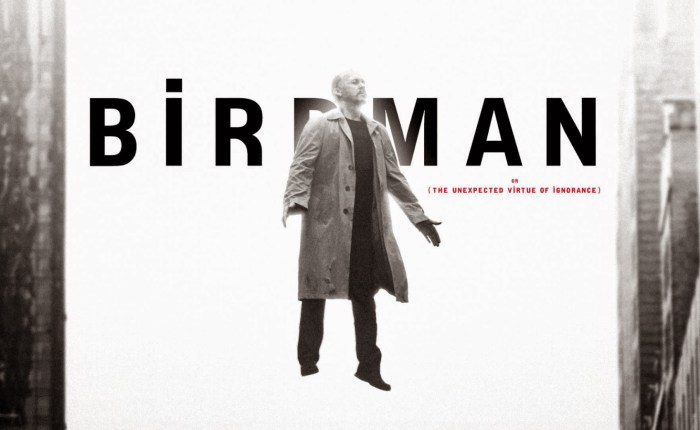
The movie opens with Michael Keaton’s character, the faded, former Hollywood star Riggan Thomson, meditating. What is instantly striking is the sight of him doing so whilst levitating cross-legged three-feet up from the floor. And so the almost continuous camera stream rolls on from there, giving us the first metaphor for Riggan’s mental state and perception of the world.
 
Keaton’s character is hounded by self-doubt, the need for validation, and the voice of the Birdman character he successfully portrayed in a three-movie franchise. His last roll of the dice, financially and from a career perspective, is a Broadway production of the Raymond Carver short story collection, What We Talk About When We Talk About Love. From the start we see the turmoil descend into madness, dragging Riggan down in the process.
 
Strong performances from each member of the cast help the pacing remain concise. Not since Pulp Fiction has a movie felt so unique, fresh, or a redefining moment within the rules of the cinematic experience. Just like that movie, star-studded names give career defining characters. Admittedly, Pulp Fiction had more of those names, but the handful here are plentiful for the scope of the story. Edward Norton reveals another side to his range as he balances what could possibly be Michael Keaton’s grandest creation to be caught on celluloid.
 
Unlike Pulp Fiction, a movie that cut back and forth, we are thrown headlong into the story that never looks back and each step forward presents a new danger. As this occurs the inner voice of Birdman grows more dominant. There are moments that have clearly been lifted from real-life experiences. The director has worked backstage on Broadway productions, Keaton himself the lead in 1989’s Batman, the movie that arguably restarted the superhero craze for movie goers, and the scathing monologue from Lindsay Duncan as a Times movie critic encapsulates how “real” actors see the Hollywood extreme.
 
With such a statement being made in the film it could be easy to assume Birdman is a piece trying to defend mainstream movies. However, it is far too intelligent to pause on this singular issue, it merely acknowledges the point of view. Its moments of dark comedy also divert the mood away from a self-absorbed two-hour reflection.


Thanks to the perfect balance of cinematography, story, performances, soundtrack and the direction of the movie, few should argue with its awards haul. Sadly, it’s this recognition that has started to take away some of the shine. The rating on IMDb continues to plummet as people load the lowest rating possible to its tally. But make no mistake: this is a 5 star, 10/10 flick. It is the closest we’ll come to mainstream art. Anyone that denies its brilliance is displaying ignorance. Without it being a virtue.

Tomorrow Becomes Yesterday

Tomorrow Becomes Yesterday

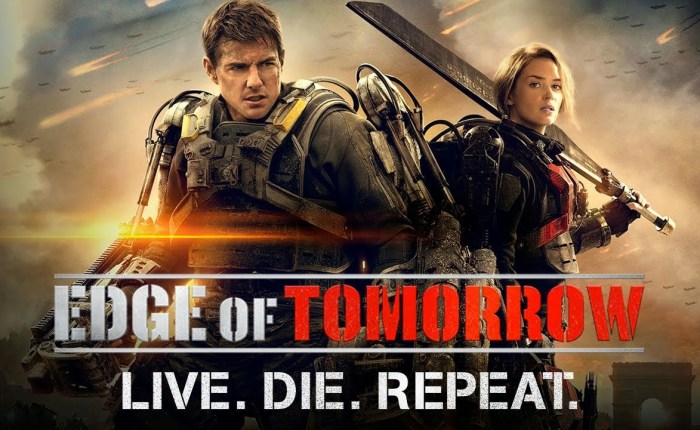
From the tagline: Live Die Repeat, and a sneak at the synopsis or a trailer, we know that Tom Cruise’s latest offering is a Groundhog Day with guns. We also see that, just like Oblivion before it, it is set in the world of science fiction. Tom Cruise is the last genuine Hollywood star, in the sense, he believes his name alone can bring box office success, rather than relying on a famous or established franchise. Yet, recent figures show is star, at least in North America, could be fading. Edge of Tomorrow attempts to repeat his former glories.

It is hard to distinguish Cruise’s modern set of films in traditional terms. The movie makers would argue that the global markets play a larger role than yesteryear. That not breaking even at home doesn’t matter when foreign totals smash the production budget. And it seems that outside of North America the Tom Cruise product is still very strong. What makes receipts over personal popularity incomparable across markets is the way different cultures absorb trends. Whether some parts of the world still adore Tom the same, or if they’re more likely to listen to positive reviews from critics, is hard to ascertain.

What we can determine is that Edge of Tomorrow promised an intriguing idea. Why it failed to garner more attention in America is a puzzle to me. Perhaps some were concerned after the lukewarm response to Oblivion (a film I quite liked). Once buckled into the film, after twenty minutes have passed, it’s clear the intriguing idea is being delivered into a top quality film.

It could have been so easy to fall into action film clichés, played it safe or worse still, played it lazy, but Edge of Tomorrow never does this. It feels authentic, like it’s aware and confident of the feel and direction it wishes to take. It harks back to action films from the 80s that set genre defining tones. Sure, it nods its head to things that have passed before; however, it only does this because sometimes those ingredients are required.

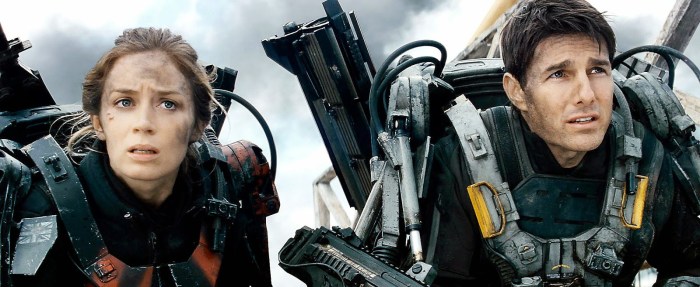
Also, make no mistake: it is packed with action scenes. Unlike most modern action flicks these aren’t there as filler. Like Aliens, a benchmark for all shoot-em-up films, the action belongs. It is never there for the sake of it until we get to the next scene with dialogue. Indeed, this story requires the repetition of action scenes, it’s what drives Cruise’s character, Major William Cage, along. The characters do develop, too. And unlike regular modern films in this genre, we are offered subtleties over spoon-fed emotions and progression. Discreet lines pass between Cruise and Emily Blunt’s female lead that never get the spelled-out, typical Hollywood, resolution. We just know it was there.

Blunt Cruise

Certain design aspects pay homage to what has gone before. The combat suit springs to mind. That particular piece of kit also could remind a person of video games, Halo isn’t a million miles away. It’s fitting that a video game gets a mention; they operate on characters “re-spawning” to rejoin the action, not unlike this movie. Also, the author admitted to using video games as an inspiration as he completed the story.

Don’t allow this comparison to fool you or degrade the vision of the movie, it’s not a simple run-through of a film. Okay, it’s not complex either; it just has that correct feel. It is solid storytelling combined with valid action, as opposed to over the top CGI and words that mean nothing.

While it is easy to criticise Tom Cruise for chasing a legacy as the leading superstar over deep, challenging roles (Born on the Fourth of July was way back in 1989, there were only a few roles with depth in the 90s, nothing since), if he seeks out this sort of popular film his talent isn’t totally wasted.

Could the ending be better? Perhaps? But one feels this film is all about the journey, not the destination. And thankfully for Tom, he’s waking up in a tomorrow where he still can command top billing whilst distancing himself from the slips of recent yesterdays.

Cruise Top Gun